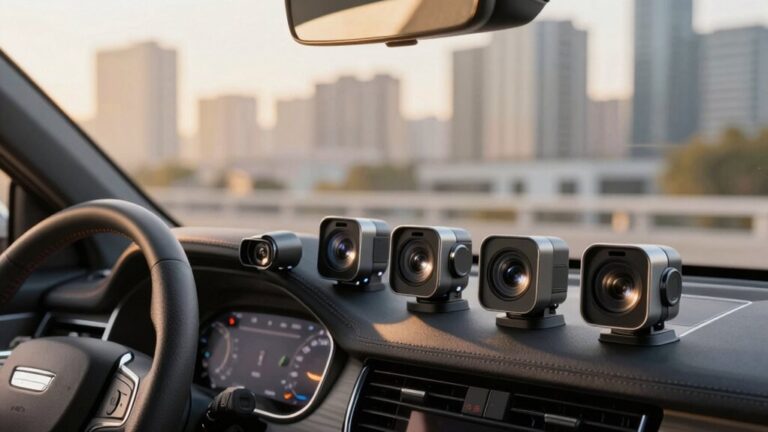

Your dash cam can’t record without electrical power, but models with built-in lithium-ion batteries typically run for 4 to 20 minutes after you disconnect the 12V input, while capacitor-based units only sustain operation for seconds. Most dash cams require consistent 12V to 16V input and draw up to 1.6A during active recording. Internal batteries primarily guarantee safe shutdown rather than extended autonomous operation. For prolonged parking surveillance, you’ll need external battery packs or hardwired voltage cutoff modules to maintain continuous power while protecting your vehicle’s starting battery from deep discharge scenarios.
Understanding Dash Cam Power Requirements
When your dash cam loses power, understanding its electrical requirements becomes critical to diagnosing the failure. Your device needs consistent 12V to 16V input, typically drawing up to 1.6A during operation. This power supply comes from three primary sources: the cigarette lighter socket, USB ports delivering 5V, or hardwired fuse box connections. However, many USB ports can’t provide adequate current, causing unstable operation and footage corruption. Installation tips include verifying your power source meets minimum requirements—chargers below 1A output won’t sustain most dash cams. For hardwiring, you’ll need fuse taps rated between 2A and 5A on the camera circuit. Accessory power lines eliminate battery drain but disable parking mode, while constant power maintains full functionality at the cost of potential battery depletion. Hardwire kits often include a voltage cut-off feature that protects your car battery from excessive drainage during extended parking mode operation. Advanced adapters can simultaneously power two devices while displaying voltage and current usage on an LCD screen. Some dash cams can alternatively draw power from the OBD port, which remains powered when the vehicle is off. Most dash cams contain lithium-ion batteries that provide 20 to 45 minutes of independent operation when disconnected from external power sources. When routing power cables, tuck them along the windshield and A-pillar trim to maintain a clean appearance and prevent interference with vehicle operation. Professional installation typically ranges from $50 to $150, covering labor and wiring, though costs can be higher for advanced models or multi-camera systems requiring complex hardwiring.
Built-In Batteries vs. Capacitors: What’s the Difference?
Two distinct energy storage technologies power modern dash cams: lithium-ion batteries and supercapacitors. Batteries utilize electrochemical reactions to deliver 5-10 minutes of autonomous operation, enabling parking mode functionality without hardwiring. However, battery lifespan degrades considerably when exposed to temperatures below -10°C or above 60°C, typically failing within 2-5 years under constant charge cycles.
Capacitors store electrical charge across dielectric materials, providing mere seconds of power—sufficient only for safe file saving during shutdown. They excel in capacitor safety, maintaining stable operation from -20°C to 70°C without swelling or thermal runaway risks. While capacitors can’t sustain extended recording independently, their virtually unlimited charge cycles guarantee superior longevity in extreme environments. Supercapacitors enable dash cams to continue recording briefly after vehicle power is cut, capturing crucial footage during accidents or power interruptions. Capacitors also charge faster than batteries, enhancing overall dashcam performance and reliability. You’ll need continuous 12V input for capacitor-based systems, whereas battery-equipped units offer standalone operation at higher replacement costs. External battery packs provide an alternative solution by supplying dedicated power during parking surveillance without draining the vehicle’s battery. When installing dash cams, ensure they’re positioned to avoid obstructing the driver’s view, typically behind the rearview mirror or within designated windshield zones. For vehicles that remain parked for long periods, battery-equipped dash cams with parking mode enabled should incorporate low voltage protection to prevent battery depletion. To ensure reliable footage storage, select micro SD cards with appropriate speed classes like U3 or V30 that can handle continuous high-resolution recording without file corruption.
How Long Can a Dash Cam Run on Internal Battery Alone?
Most dash cams equipped with internal lithium-ion batteries deliver 4 to 20 minutes of autonomous operation once you disconnect external 12V power, though actual runtime hinges on battery capacity measured in milliamp-hours (mAh) and instantaneous current draw. Series 2 models with 500 mAh cells typically sustain 10 minutes of recording at 3.7 V nominal voltage before triggering low-voltage shutdown. Internal battery performance degrades when parking mode remains active, since continuous motion detection and voltage regulation circuits drain 1–5 watts continuously. You’ll notice dash cam runtime shrinks further if you’ve enabled rear-camera feeds or high-resolution encoding, both amplifying amperage requirements. Legacy units may only provide 4-minute bursts—just enough for orderly file closure. Fundamentally, these batteries serve as uninterruptible power supplies for safe shutdown, not extended surveillance without hardwired supplemental power.
External Battery Packs for Extended Operation
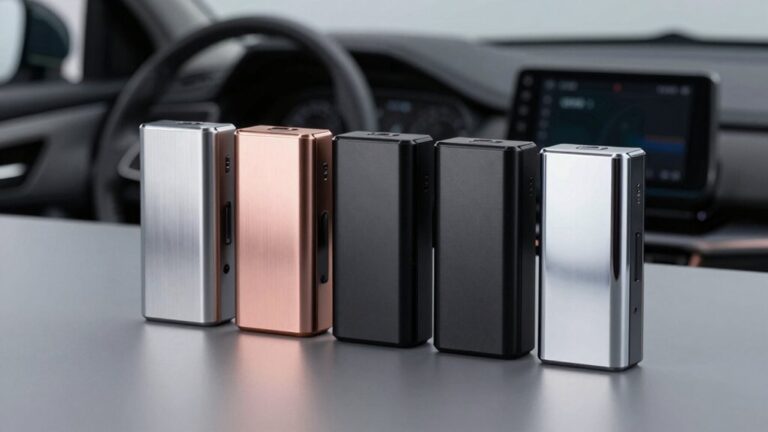
Anyone serious about parking-mode surveillance needs external battery packs that decouple dash-cam operation from the vehicle’s 12 V starting battery, delivering regulated DC power through cigarette-lighter outlets or hardwire terminals while the ignition remains off. Typical 7,500–7,650 mAh packs sustain 32-hour recording intervals without draining your automotive cranking supply, preserving warranty coverage and eliminating no-start risk. Battery pack portability enables multi-vehicle deployment—you’ll move rechargeable cells between cars without rewiring harnesses. Premium units integrate protection features: overcharge lockout at 4.2 V per lithium cell, thermal cutoff above 60°C, short-circuit isolation, and low-voltage disconnect preventing deep discharge below 2.5 V. Dual outputs power your camera plus USB peripherals simultaneously, while 70-minute fast-charge cycles via 12 V DC inputs guarantee rapid turnaround between shifts or overnight sessions.
Hardwiring Your Dash Cam to the Vehicle Electrical System
Installation tips: tap constant-power circuits (taillights, interior lights) for 24/7 recording or accessory circuits (radio, HVAC) for ignition-dependent operation. Ground the negative lead to bare chassis metal—paint insulates and causes voltage drops. Voltage cutoff modules prevent over-discharge below 11.8 V threshold, preserving cranking capacity during extended surveillance. Use add-a-fuses when connecting to the fuse box to enhance installation security and protect your dash cam’s power supply. Hardwire kits and power modules for popular dashcam brands enable safe, permanent wiring into the vehicle’s fuse box or OBD-II port, supporting features like parking mode and battery voltage monitoring. Many modern dash cams also offer mobile app integration for real-time monitoring and video access directly from your smartphone. Hardwired dash cams with parking mode provide continuous surveillance that deters theft and vandalism even when your vehicle is unattended. For comprehensive vehicle monitoring, consider 3-channel dash cams that capture front, rear, and interior footage simultaneously for maximum security coverage. Route and hide wires neatly along the trim for a professional finish that keeps the installation clean and unobtrusive.
USB and Cigarette Lighter Power Options
When you’re not ready to commit to permanent electrical modifications, USB and cigarette lighter connections deliver straightforward power solutions for dash cam operation. USB ports typically supply 5V, enabling plug-and-play dash cam connectivity for compatible models, though power output varies by vehicle manufacturer and port specification. The 12V cigarette lighter socket provides stable voltage through ignition-switched circuits, automatically controlling recording cycles with engine status. This power source comparison reveals distinct advantages: USB minimizes adapter requirements while cigarette lighter adapters offer regulated 12V delivery with internal voltage conversion. However, you’ll face limitations—USB ports may lack sufficient amperage for high-resolution recording, and constant-power cigarette sockets risk battery depletion without smart power modules. Both methods support driving-mode operation effectively, yet parking surveillance typically requires supplemental battery packs or hardwired configurations with voltage monitoring capabilities. Modern dash cams with Wi-Fi connectivity enable convenient wireless file transfers and app-based configuration without requiring cable connections to your phone. Choosing power sources that match your dash cam voltage requirements ensures optimal device longevity and performance. Regardless of your power configuration, most dash cams require an SD card to store recorded footage since built-in memory remains uncommon in these devices. Regular SD card formatting helps maintain the card’s health and prevents data corruption caused by the dash cam’s continuous writing process. Advanced models may integrate G-sensors for detecting impacts alongside GPS to provide comprehensive accident documentation and verification capabilities. USB connectivity eliminates complicated wiring installations that traditional power sources typically require.
Parking Mode and Power Consumption
Parking mode transforms your dash cam into a surveillance device during vehicle standby, but this extended operation introduces critical power management challenges that directly threaten battery health. Typical parking mode efficiency draws 100-300 mA at 12V, with standard models consuming approximately 300 mA (~4W). At this continuous current draw, your 80 Ah battery depletes to critical voltage thresholds within 12-24 hours, risking startup failure below 12V.
Effective battery management requires hardwire kits with low-voltage cutoff protection or external battery packs like PowerCell systems. Ultra-low power models reduce consumption to 2 mA through motion-activated sleep states, dramatically extending operational duration. Modern systems use motion detection features with G-sensors and visual sensors to activate recording only when movement is detected around the vehicle, conserving both memory and power. You’ll sacrifice some event capture during wake-up delays, but you’ll preserve battery integrity. Understanding the different types of dash cams available helps you select models with power-saving features that match your parking mode requirements and battery capacity. Without voltage protection circuits, prolonged parking mode operation guarantees deep discharge and potential battery damage. Car batteries should not be discharged below 50% to maintain longevity and avoid permanent capacity loss. When implementing parking mode, consider audio recording laws in your jurisdiction, as continuous recording may raise legal concerns about capturing conversations without consent. Hardwiring dash cams provides uninterrupted power supply that enables reliable 24/7 recording capability essential for comprehensive parking lot protection. Advanced parking mode capabilities include time-lapse parking recording that captures frames at intervals, providing extended monitoring while minimizing power consumption and storage requirements.
Preventing Car Battery Drain With Voltage Cutoff Features
Voltage cutoff systems function as automated circuit breakers that monitor your battery’s state of charge and terminate dash cam power draw before reaching critical discharge levels. These devices typically enforce voltage thresholds between 12.0V and 12.3V, with shutdown occurring only after sustained low voltage persists for approximately five minutes—preventing false triggers from transient voltage dips. You’ll find cutoff activation exclusively during ignition-off periods, ensuring uninterrupted operation while driving. Many systems incorporate conservative margins, disconnecting slightly above configured thresholds for enhanced battery preservation. Adjustable cutoff parameters allow you to optimize the trade-off between parking mode duration and discharge protection based on your battery’s condition and capacity. Hardwire kits and OBD-II cables frequently integrate these cutoff circuits, eliminating external components while maintaining systematic protection against deep-cycle damage. Hardwired dash cams equipped with voltage cutoff features eliminate the need for manual unplugging between uses. These built-in battery protection features are particularly crucial in colder weather conditions when batteries are more susceptible to depletion. Most dash cams draw between 0.15 to 0.3 amps during normal recording, while parking mode operation requires only 0.1 to 0.3 amps of current. For extended parking mode recording without draining your vehicle battery, dedicated battery packs offer safer and more reliable power delivery compared to standard USB power banks. To ensure reliable evidence capture during continuous operation, dash cams require high endurance SD cards specifically engineered to withstand intensive read/write cycles and prevent data corruption.
Power Quality and Its Impact on Recording Performance
Though often overlooked during installation, your dash cam’s power quality directly governs recording reliability through voltage stability, ripple suppression, and transient protection. Power fluctuations cause abrupt shutdowns, corrupting files and triggering processor instability that degrades video quality. When voltage drops below operational thresholds, your camera experiences frame rate inconsistencies and potential freezing. Conversely, surges stress internal components, accelerating hardware degradation.
Hardwired installations provide superior performance reliability compared to cigarette lighter adapters, which often deliver unregulated current with significant ripple. USB ports in vehicles may supply inadequate amperage, causing reboots during high-load recording. Cable quality matters—poor connections introduce voltage drops that manifest as flickering or sudden shutdowns. Battery-powered dash cams may experience performance issues in extreme temperatures, unlike capacitor-based models that maintain more stable operation. Implementing regulated power sources or voltage stabilizers guarantees consistent 12V delivery, maintaining prime processor performance and preserving recording integrity across all operational modes. Professional installation by experts ensures proper power configuration and optimal dash cam performance throughout all recording scenarios.
Best Power Solutions for Different Vehicle Types
Your vehicle’s electrical architecture determines which power solution delivers ideal dash cam performance. Newer models with constant-power USB ports support direct connection, while older vehicles require hardwiring kits accessing the fuse box for 12V continuous supply. Vehicle compatibility depends on electrical system design—Chevrolet, Hyundai, Jeep, and Porsche offer brand-specific adapters guaranteeing proper voltage regulation and simplified routing. For installation tips, consider your dash cam’s current draw: standard units need 5V 1A, while mirror-style cameras demand higher amperage. External battery packs (7,500+ mAh capacity) eliminate vehicle modification entirely, ideal for leased vehicles or temporary installations. Smart hardwiring kits with voltage cutoff protection prevent battery depletion by disconnecting at preset thresholds, typically 11.8V for lead-acid batteries. Rear view mirror power adapters offer an alternative installation method that pulls power directly from the mirror’s existing electrical connection, eliminating the need to access the fuse box. Professional installation guarantees proper circuit integration and prevents electrical system interference.