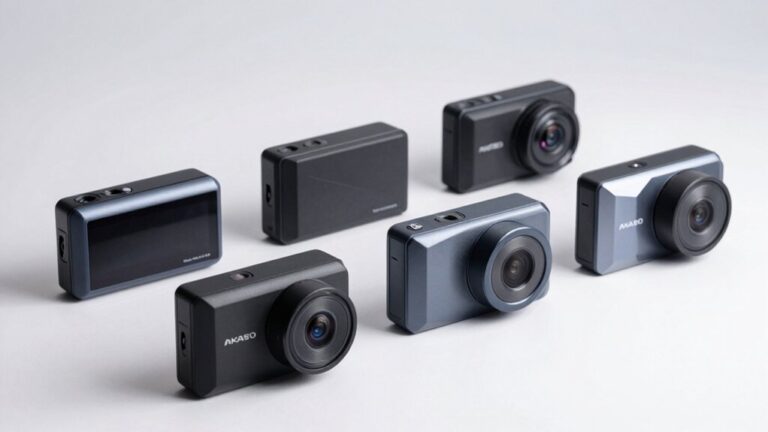

Yes, you can power your dash cam with an external battery pack if it delivers the correct voltage—typically 5V via USB or regulated 12V—and sufficient amperage matching your camera’s specifications. Most packs use LiFePO4 or lithium-ion cells with capacities from 4,500mAh to 12,000mAh, providing anywhere from 8 to 32 hours of parking mode recording depending on whether you’re running a single-channel or dual-channel system. The sections below explain compatibility requirements, runtime calculations, and ideal installation practices.
How Dash Cam Battery Packs Function With Different Camera Models
When selecting a battery pack for your dash cam, understanding voltage compatibility proves critical since most automotive cameras operate on either 5V USB power or direct 12V/24V vehicle power rails. Battery pack compatibility depends on matching your camera’s input specifications—universal USB outputs provide 5V power for broader camera model integration, while dedicated 12V/24V outputs serve hardwired installations. Brand-optimized packs like BlackVue B-130A include direct power cables that streamline installation with supported models, whereas cross-brand applications typically require compatible parking surveillance cables or adapters. Smart current regulation adjusts output dynamically based on your dash cam’s power draw, preventing voltage fluctuations that could disrupt recording. Multi-voltage systems supporting both 12V and 24V rails expand compatibility across commercial and passenger vehicles, making them versatile solutions for various camera configurations. Modern battery packs utilizing LiFePO4 battery technology deliver enhanced longevity and thermal stability compared to traditional lithium-ion cells. Dash cams with supercapacitor power systems, like the Rove R2-4K Dual, offer exceptional durability in extreme temperatures when paired with appropriate battery backup solutions. Premium models feature ignition monitoring capabilities that automatically trigger parking mode recording when the vehicle is turned off. Advanced dash cams such as the Nextbase 522GW benefit from battery pack integration, which enables Intelligent Parking Mode to record incidents even when the vehicle is unattended. While battery packs offer portable power solutions, hardwire kits provide a constant power source by connecting directly to the vehicle’s electrical system for truly continuous operation. Hardwiring kits connect to the car’s fuse box for permanent installations that support advanced features like parking mode surveillance.
Battery Pack Capacities and Expected Recording Times
Most dash cam battery packs employ either LiFePO4 or lithium-ion cells with capacities spanning 4,500mAh to over 12,000mAh, though watt-hour ratings provide more accurate runtime predictions since they account for voltage differences across architectures. For 1-channel cameras drawing 2–3W, a 96Wh pack delivers approximately 32 hours of parking mode recording, while 256Wh units can exceed 80 hours. Recording efficiency drops with 2-channel systems consuming 4–6W—the same 96Wh pack provides only 19 hours at 5W. Power consumption directly impacts runtime: higher bitrates and frequent event triggers reduce available recording time. The IROAD Power Pack Pro 12’s 153Wh rating suits extended multi-day parking scenarios. The BP100’s compact and portable design makes it particularly suitable for installation in tight dashboard spaces while maintaining easy access for maintenance. Battery-powered dash cams provide reliable recordings even when the vehicle is off or loses power, making them ideal for flexible installation and continuous protection. When installing a battery pack, ensure it does not obstruct the driver’s line of sight as mounting placement regulations vary by state. Strategic placement behind the rearview mirror helps minimize exposure to direct sunlight and reduces the risk of overheating during extended operation. For users seeking permanent installations, hardwire kits can connect directly to the vehicle’s fuse box to support parking mode features while protecting the battery with voltage monitoring. Budget-friendly options like the Rexing V1P Pro Dual with Wi-Fi and parking mode features under $200 pair well with external battery packs for extended surveillance applications.
Protecting Your Vehicle’s Electrical System From Drain
While dash cams provide essential surveillance capabilities, their constant power draw poses a measurable risk to your vehicle’s 12V electrical system—particularly the starter battery, which wasn’t designed to handle sustained parasitic loads. Standard dash cams consume 0.5–2 amps during recording and 0.1–0.3 amps in parking mode, which steadily depletes battery capacity during extended inactivity.
Effective power management requires hardwiring with voltage cutoff devices that disconnect the dash cam when battery voltage drops below critical thresholds (typically 11.6V). These safety measures preserve enough charge for engine starting while preventing deep discharge cycles that degrade battery health. Without proper cutoff protection, hardwired installations create parasitic drain that forces your alternator into sustained high-output operation—accelerating wear on both components through repeated undercharge-recharge cycles. Many dash cams feature motion detection capabilities that activate recording only when movement is sensed, helping to conserve power and reduce battery drain during parking mode. To ensure optimal performance and avoid electrical issues, consider using professional installation services that can properly configure voltage cutoff protection and hardwiring for your specific vehicle type. A dedicated battery pack offers an alternative power solution that operates independently from your vehicle’s electrical system, eliminating concerns about starter battery drainage. Alternatively, connecting through the cigarette lighter port provides automatic power cutoff when the engine is off, offering a simpler solution for drivers who want to avoid battery drain without hardwiring. Beyond protecting your vehicle’s electrical components, maintaining proper dash cam operation safeguards the footage that can prevent wrongful liability claims and help avoid premium increases after accidents.
Setting Up and Installing a Dash Cam Battery Pack
Before connecting any wires, you’ll need to select a battery pack location that balances thermal management with electrical efficiency—prioritizing areas with ambient airflow under 45°C to prevent capacity loss in lithium-ion cells. Optimize battery pack placement under the passenger seat or trunk, ensuring ventilation pathways remain unobstructed and moisture-free.
For power connection, you’ve got two pathways: 12V socket integration or direct hardwire to the fuse box. Hardwiring delivers superior charging currents (typically 2-5A) and enables automatic parking mode activation. Use an add-a-fuse adapter rated 20-30A, tapping into an ignition-switched circuit to prevent parasitic drain. External battery packs charge while driving and provide backup power when the vehicle is off, ensuring your dash cam maintains functionality without compromising your car’s starting ability. Many battery packs include low-voltage cut-off features that automatically stop power supply to protect against excessive discharge.
Route output cables to your dash cam using manufacturer-specified connectors, verifying voltage compatibility (5V or 12V). For a clean installation, consider routing cables neatly behind trim panels to hide wiring from view and maintain your vehicle’s interior aesthetics. Secure all connections with heat-shrink insulation and validate system operation through complete charge-discharge cycles. During normal operation, dash cams consume minimal power of around 1-5 watts, which the battery pack can easily sustain for extended periods. To further enhance footage quality, consider adding a polarizing filter to reduce dashboard reflections and windshield glare that can obscure critical details in your recordings. When selecting your setup, consider essential features like 4K resolution, night vision, and app support to maximize your dash cam’s performance.
Battery Chemistry Options and Temperature Performance
Once you’ve identified ideal placement and wiring paths for your dash cam battery pack, the chemistry you select determines thermal tolerance and operational longevity under real-world voltage demands. Lithium-ion cells deliver high energy density but exhibit temperature sensitivity between -10°C and 60°C, degrading faster under thermal stress. Supercapacitors operate reliably from -20°C to 70°C without degradation, though their limited capacity restricts parking mode runtime. LiFePO4 variants extend battery lifespan with superior thermal stability across 0°C to 50°C charging cycles. For extreme environments, Lithium Thionyl Chloride withstands up to 85°C, while enhanced NiMH formulations function from -40°C to +85°C. Multi-layer protection circuits monitor voltage thresholds and temperature excursions, triggering automatic shutdowns before thermal runaway conditions develop. Supercapacitors require a constant power source to function and cannot hold a charge independently, making them unsuitable for standalone battery pack applications without continuous vehicle power connection. Supercapacitors significantly reduce fire risks compared to lithium-ion batteries, offering enhanced safety in high-temperature vehicle environments where thermal events pose the greatest concern. When routing power cables from your battery pack to the dash cam, secure connections using proper attachment methods prevent voltage drops that compromise recording stability during temperature fluctuations. Modern dash cams integrate parking mode recording features that draw continuous power from battery packs to capture incidents while the vehicle remains stationary. Advanced models incorporate buffered motion detection to minimize false triggers while maintaining surveillance readiness during extended parking periods. Formatting your memory card using the dash cam’s onboard formatting option rather than computer utilities prevents compatibility issues that could compromise continuous recording reliability during extended battery-powered operation.
Monitoring and Maintaining Your Battery Pack’s Health
Although dash cam battery packs operate autonomously, continuous voltage and temperature monitoring prevents catastrophic failure modes that compromise both recording integrity and vehicle safety. You’ll need to track State of Charge (SOC) and State of Health (SOH) metrics through your pack’s integrated Battery Management System, which measures cell-level voltage differentials and internal resistance changes. Implement maintenance practices including keeping charge levels between 20-80% to minimize degradation cycles, and verify your BMS thermal cutoffs trigger below 60°C ambient exposure. Self-discharge current measurement detects internal shorts post-installation, while periodic open circuit voltage tests reveal cell imbalance requiring rebalancing protocols. Third-party monitoring apps provide granular cycle tracking beyond native indicators, enabling predictive maintenance before capacity loss impacts your dash cam’s parking mode runtime specifications. Advanced systems now incorporate electrochemical model-based observers that estimate lithium concentration in real-time, providing deeper insight into internal battery states that conventional voltage-based monitoring cannot detect. When recording does occur, pairing your battery pack with high endurance SD cards ensures the continuous read/write cycles won’t result in data corruption during extended parking surveillance sessions. Modern dash cams with Wi-Fi connectivity allow you to remotely check recording status and battery levels through smartphone apps without physically accessing the device.
Popular Battery Pack Models and Price Considerations
Several dedicated battery packs now dominate the dash cam aftermarket, each engineered with distinct power delivery architectures and thermal management systems that directly impact your parking surveillance capabilities. Battery pack comparisons reveal critical specifications: the BlackVue B-130X delivers 12.8V at 7500mAh through LiFePO4 chemistry, supporting 30-hour single-channel operation, while VIOFO’s BP100 matches capacity with dual outputs and expandable configuration to 22950mAh. The IROAD Power Pack Pro 12’s 153Wh capacity extends runtime considerably beyond compact alternatives like Thinkware’s 57.6Wh iVolt Mini. Pricing strategies segment the market distinctly—entry-level units start at $209, mid-range solutions occupy the $349 bracket, and premium high-capacity systems reach $399. Your selection hinges on required ampere-hours, charge cycle longevity, and thermal cutoff thresholds matching your surveillance duration needs. All battery packs maintain universal dash cam compatibility, eliminating brand-specific restrictions when selecting your power solution. Unlike hardwiring into the vehicle’s electrical system, battery packs provide a warranty-safe installation method that avoids potential manufacturer coverage concerns. When paired with adequate storage, these battery systems leverage loop recording functionality to continuously capture footage by automatically overwriting the oldest files once the memory card reaches capacity. Advanced models like the BlackVue DR970X-2CH LTE Plus integrate cloud storage capabilities that enable remote access to recorded events and real-time streaming from anywhere through mobile applications.
When Battery Packs Outperform Hardwired Connections
Understanding which battery pack delivers the best runtime-per-dollar ratio matters only if the deployment scenario actually favors battery operation over hardwired integration. Performance comparison reveals battery packs excel when you’re renting vehicles, transferring dash cams between multiple cars, or parking in locations where extended recording periods exceed typical hardwire low-voltage cutoff thresholds. User experience improves considerably when you lack fuse box access or want to avoid repeated charge-discharge cycles that accelerate vehicle battery sulfation. Battery packs eliminate professional installation costs and wiring errors while providing voltage-isolated operation that protects both automotive electrical systems and dash cam circuitry. They outperform hardwired connections specifically when installation permanence is undesirable, when preserving OEM electrical architecture is mandatory, or when parking duration demands exceed your vehicle battery’s safe discharge capacity. Simple plug-in setups offer quick setup requiring no tools or extensive wiring knowledge, making battery packs the ideal companion for users prioritizing convenience over permanent installation.