
You’ve invested in a quality dashcam to protect yourself on the road, but what happens when your car’s off and you’re not around? A reliable power bank keeps your dashcam recording in parking mode, capturing those critical moments when you’re away from your vehicle. Not all power banks work well with dashcams, though. You’ll need specific features like proper voltage output, sufficient capacity, and safety protections to avoid damaging your equipment or experiencing recording gaps.
Quick Overview
- Choose powerbanks with 12V output and 96-259Wh capacity for extended dashcam runtime during parking mode.
- Ensure voltage compatibility with XT30 outputs and built-in BMS for vehicle electrical system protection.
- Select models supporting PD or QC fast charging for quick recharge times, ideally under 60 minutes.
- Prioritize LiFePO4 cells with overheat protection and temperature monitoring for extreme weather reliability.
- Balance capacity with compact dimensions and verify FCC, CE, RoHS certifications for safe operation.
| 70000mAh Portable Charger 30W Fast Charging Power Bank |

| Best High Capacity | Battery Capacity: 70000mAh / 259Wh | Charging Time: Not specified | Output Ports: 2 USB (30W each), 1 USB-C (20W) | VIEW LATEST PRICE | Read Our Analysis |
| Blackvue B-130A Ultra Battery for Dash Cams |

| Best for BlackVue | Battery Capacity: 7,500mAh / 96Wh | Charging Time: 50 min (hardwired) or 90 min (cigarette lighter) | Output Ports: Not specified | VIEW LATEST PRICE | Read Our Analysis |
| RoyPow 30W PD Portable Charger with Cigarette Lighter |

| Most Versatile | Battery Capacity: 23400mAh / 86.58Wh | Charging Time: 4 hours | Output Ports: USB-C PD (30W), USB-A QC 3.0 (18W), USB-A (12W), 12V DC, cigarette lighter | VIEW LATEST PRICE | Read Our Analysis |
| 70mai Dash Cam Battery Pack BL96NNX 96Wh |
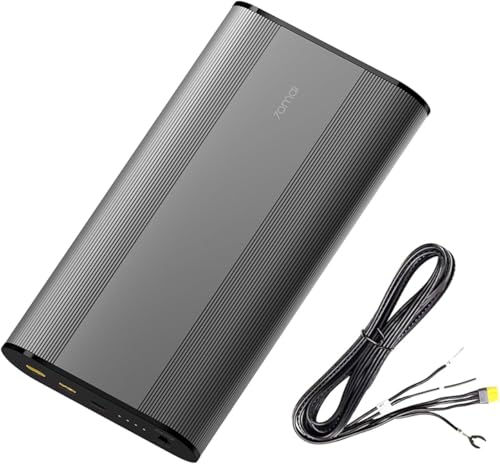
| Best Overall | Battery Capacity: 7500mAh / 96Wh | Charging Time: 60 minutes (hardwired) | Output Ports: XT30, Type-C | VIEW LATEST PRICE | Read Our Analysis |
More Details on Our Top Picks
70000mAh Portable Charger 30W Fast Charging Power Bank
If you need a reliable power source for extended dashcam recording during road trips or emergencies, the 70000mAh Portable Charger stands out with its massive 259Wh capacity. You’ll get 30W fast charging through two USB ports and a 20W USB-C port, letting you power your dashcam alongside four other devices simultaneously. The LED display tracks remaining power, while the compact 5.7 x 2.7 x 2-inch design weighs just 29.5 ounces. It’s not airline-approved but excels for camping trips and outdoor adventures. Built-in protections against overcharging and short circuits guarantee your dashcam stays powered safely.
- Battery Capacity:70000mAh / 259Wh
- Charging Time:Not specified
- Output Ports:2 USB (30W each), 1 USB-C (20W)
- Weight:29.5 ounces (0.83 kg)
- Safety Features:Overcharging protection, short circuit protection, auto shut-off
- Dimensions:5.7 x 2.7 x 2 inches
- Additional Feature:Charges 5 devices simultaneously
- Additional Feature:Soft hanging lanyard included
- Additional Feature:LED display shows percentage
Blackvue B-130A Ultra Battery for Dash Cams
The Blackvue B-130A Ultra Battery stands out as the ideal power solution for drivers who need extended parking mode surveillance without risking their vehicle’s battery. With its 12.8V/7,500mAh/96Wh capacity, you’ll get up to 30 hours of single-channel or 19 hours of dual-channel recording. The fast-charging feature lets you recharge in just 50 minutes when hardwired or 90 minutes via cigarette lighter. Built with LiFePO4 cells and full aluminum casing, it offers superior durability and heat dissipation. Overheat protection automatically suspends charging and alerts you to temperature or voltage issues, ensuring safe operation.
- Battery Capacity:7,500mAh / 96Wh
- Charging Time:50 min (hardwired) or 90 min (cigarette lighter)
- Output Ports:Not specified
- Weight:4.71 pounds
- Safety Features:Overheat protection, temperature/voltage alerts
- Dimensions:9.33 x 7.44 x 3.82 inches
- Additional Feature:30-hour single-channel recording
- Additional Feature:Full aluminum casing
- Additional Feature:LiFePO4 cell technology
RoyPow 30W PD Portable Charger with Cigarette Lighter
Looking for a powerbank that can actually replace your car’s cigarette lighter socket? The RoyPow 30W PD Portable Charger delivers exactly that with its 12V 10A constant voltage outlet. You’ll get 86.58Wh capacity in a compact 630g package that’s airplane-friendly.
This powerbank features multiple charging options: 30W USB-C PD, 18W Quick Charge 3.0, and a regulated 13.5V 6A 81W cigarette lighter outlet. You can power your dashcam, car refrigerator, vacuum cleaner, or air compressor simultaneously. It fully recharges in 4 hours and includes built-in protection against overload and short circuits, backed by FCC, CE, and RoHS certifications.
- Battery Capacity:23400mAh / 86.58Wh
- Charging Time:4 hours
- Output Ports:USB-C PD (30W), USB-A QC 3.0 (18W), USB-A (12W), 12V DC, cigarette lighter
- Weight:630g
- Safety Features:Lithium battery protection chip, overload/short circuit protection, FCC/CE/RoHS certified
- Dimensions:6.25 x 6.25 x 13 cm
- Additional Feature:12V cigarette lighter socket
- Additional Feature:Plane-suitable portable design
- Additional Feature:Powers car refrigerators/compressors
70mai Dash Cam Battery Pack BL96NNX 96Wh
For dash cam enthusiasts seeking extended parking surveillance without draining their vehicle’s battery, the 70mai Dash Cam Battery Pack BL96NNX delivers up to 30 hours of continuous recording on a single charge. Its 96Wh LiFePO4 chemistry provides exceptional longevity, maintaining 70% capacity after 2,000 cycles.
You’ll appreciate the rapid 60-minute charging through hardwired connection and universal compatibility via XT30 output that simulates car battery signals. The detailed Battery Management System offers seven protection features, including low voltage protection and a fuse box solution. Weighing 4.31 pounds with dimensions of 11.02 x 6.54 x 2.91 inches, it’s compact enough for discreet installation while providing reliable backup power.
- Battery Capacity:7500mAh / 96Wh
- Charging Time:60 minutes (hardwired)
- Output Ports:XT30, Type-C
- Weight:4.31 pounds
- Safety Features:Low voltage protection, Battery Management System with 7 protections, fuse box
- Dimensions:11.02 x 6.54 x 2.91 inches
- Additional Feature:2,000+ cycle lifespan
- Additional Feature:XT30 simulates battery signals
- Additional Feature:20-second delayed charging
Factors to Consider When Choosing a Powerbank for Dashcam
Selecting the right powerbank for your dashcam requires careful evaluation of several critical specifications. You’ll need to match the battery capacity to your desired recording duration while ensuring the voltage output is compatible with your specific dashcam model. Consider how quickly the powerbank charges, whether it includes temperature protection to prevent heat damage, and how easily you can mount it in your vehicle.
Battery Capacity and Runtime
When choosing a powerbank for your dashcam, battery capacity stands as the most critical specification you’ll need to assess. Measured in milliampere-hours (mAh) or watt-hours (Wh), this determines how long your camera operates without draining your vehicle’s battery. Higher-capacity models, such as 96Wh or 7500mAh units, deliver up to 30 hours of continuous recording for single-channel dashcams.
You’ll also want to take into account charge time and cycle life. Rapid charging features can replenish your powerbank in 50-60 minutes, maximizing efficiency. For longevity, select a powerbank that maintains at least 70% capacity after 2,000 charging cycles. Additionally, verify your chosen model includes safety features that prevent vehicle battery drainage while parked, protecting your car’s starting capabilities.
Voltage Compatibility Requirements
Voltage compatibility determines whether your powerbank will effectively power your dashcam without causing damage or performance issues. Most dashcams require approximately 12V output, so you’ll need to verify your powerbank matches this specification. Look for models with universal compatibility featuring XT30 outputs that simulate car battery signals (VCC/ACC/GND).
Your powerbank’s input voltage range should accommodate 11.2V to 30V for reliable performance across various conditions. Quality dashcam batteries include a built-in Battery Management System (BMS) that maintains proper voltage levels and protects your vehicle’s electrical system from potential damage.
Proper voltage matching prolongs both your dashcam’s and powerbank’s lifespan while enabling extended parking mode recording. This prevents draining your vehicle’s battery during extended monitoring periods.
Charging Speed and Methods
Charging speed directly impacts your powerbank’s usability and convenience for dashcam applications. Look for units supporting PD (Power Delivery) or QC (Quick Charge) technologies, which can greatly reduce charging times compared to standard methods. Hardwired connections typically offer the fastest performance, with some models achieving full charge in just 50 minutes.
Consider your charging method carefully. While hardwired installations provide superior speed, they require professional setup. Portable options using cigarette lighter sockets offer flexibility but may charge more slowly. Make sure your chosen powerbank provides multiple output options, including USB-C and traditional ports, to accommodate different dashcam models.
Faster charging means less downtime and more reliable protection for your vehicle, especially if you’re frequently starting and stopping your engine throughout the day.
Temperature Protection Features
While charging efficiency matters, your powerbank’s ability to withstand extreme temperatures determines whether it’ll actually function when you need it most. Look for overheat protection that automatically suspends charging and alerts you to temperature issues, safeguarding internal components from damage. Power banks with LiFePO4 cells offer superior thermal stability and reduced thermal runaway risk under extreme conditions.
A robust battery management system provides essential temperature monitoring and prevents overheating across varying conditions. Enhanced heat dissipation features, like aluminum casings, effectively manage operational heat and extend battery lifespan. You should regularly assess your powerbank’s operating temperature range to guarantee it stays within safe limits, protecting both the device and your dashcam from potential damage.
Mounting and Installation Options
Strategic placement of your powerbank can make the difference between seamless dashcam operation and constant frustration. You’ll need to evaluate dimensions and weight carefully, ensuring the unit won’t obstruct your visibility or feel cumbersome inside your vehicle.
Look for secure mounting solutions like adhesive pads or brackets that’ll keep the powerbank stationary during travel. You don’t want it sliding around while you’re driving.
Choose a design that provides easy access to charging ports and status indicators. This’ll simplify installation and help you monitor performance without hassle.
Verify the powerbank can withstand your vehicle’s temperature fluctuations, as extreme conditions impact performance and longevity. Additionally, confirm it includes a built-in battery management system with overcharge and short circuit protection for safe operation.
Power Delivery Standards
Understanding your dashcam’s power requirements starts with evaluating which charging standards it supports. Power Delivery (PD) protocol delivers up to 100W, making it perfect for energy-intensive dash cams through intelligent power management that enhances charging speed based on your device’s needs. Quick Charge 3.0 (QC 3.0) offers another fast charging solution, reaching 80% capacity in just 35 minutes.
When you’re selecting a power bank, verify it supports your dashcam’s specific charging standard. Look for output capabilities matching your device’s requirements—typically 12V and 30W for dash cams. Compatibility with both PD and QC 3.0 maximizes your power bank’s versatility across multiple devices during travel. This guarantees your dashcam runs reliably without draining your vehicle’s battery while maintaining peak performance.
Size and Weight Considerations
When choosing a powerbank for your dashcam, you’ll need to balance capacity against practicality—larger batteries deliver extended runtime but can create installation headaches in your vehicle’s limited space. Lightweight options enhance portability and simplify installation. Compact models measuring around 6.25 x 6.25 x 13 cm and weighing approximately 630g fit discreetly in storage compartments without monopolizing space. Conversely, heavier units weighing 4.71 pounds may offer higher capacity but sacrifice convenience due to their bulk. Evaluate the design carefully to ascertain it won’t obstruct your visibility or block access to essential controls. The capacity-to-size ratio matters considerably—higher mAh or Wh ratings typically mean larger dimensions, which directly impacts placement options within your vehicle’s interior.
Safety Certifications and Protection
Safety certifications serve as your primary assurance that a powerbank meets rigorous industry standards before it reaches your vehicle. Look for FCC, CE, and RoHS certifications that confirm reliability and environmental compliance.
You’ll need effective protection features including overheat prevention and low voltage protection to safeguard your car’s electrical system during parking mode. A robust Battery Management System (BMS) should incorporate overload and short circuit protection for thorough safety coverage.
Consider powerbanks using LiFePO4 battery chemistry, which offers superior thermal stability compared to standard lithium batteries while extending cycle life. Regularly verify that your chosen unit includes fuses and alert systems for temperature or voltage irregularities. These features prevent potential hazards during prolonged dashcam operation, ensuring both device longevity and vehicle safety.