
Your dash cam’s GPS receiver captures signals from at least four satellites orbiting 20,200 kilometers above Earth, measuring transmission delays to calculate distances. It uses trilateration algorithms to determine your vehicle’s precise location, speed, and direction, then synchronizes this data with video footage. The system corrects for atmospheric interference and signal reflections through iterative processing, creating timestamped records that combine visual evidence with telemetry data. Understanding the technical components and installation options will help you maximize positioning accuracy and functionality.
Understanding GPS Technology in Dash Cameras
GPS technology in dash cameras functions by receiving signals from orbiting satellites to determine a vehicle’s precise location, speed, and direction during operation. The GPS receiver establishes satellite connectivity by triangulating signals from multiple satellites, typically requiring at least four for accurate positioning. This process delivers location accuracy within 5 to 10 meters, sufficient for vehicle tracking and evidence collection.
However, signal interference from obstacles like buildings, trees, and mountains can degrade positioning precision. The reliability of captured data depends on both the quality of the GPS receiver hardware and the sophistication of its processing algorithms. Advanced dash cam models integrate gyro sensors with GPS data to compensate for signal loss and enhance movement tracking accuracy, ensuring continuous location monitoring even in challenging environments. Modern dash cams with Parking Mode enabled can continue recording GPS data even when the vehicle is off by utilizing hardwiring or external battery power sources. The GPS module serves as a driving black box, documenting essential information including time, speed, and geographic coordinates throughout the journey. Fleet-oriented systems utilize cloud-uploaded footage with GPS tagging to provide comprehensive location and incident data for vehicle management and driver exoneration. Many contemporary dash cams offer mobile app integration that allows drivers to view live GPS tracking data and access recorded routes directly from their smartphones. Top models feature built-in GPS alongside 4K or higher resolution video to capture both precise location data and clear visual evidence simultaneously. Premium dash cams with GPS also include built-in microphones that capture audio alongside location data, providing comprehensive documentation of incidents with sound, speed, and position information.
How GPS Receivers Calculate Vehicle Position
Calculating a vehicle’s position requires the GPS receiver to process signals from multiple satellites orbiting approximately 20,200 kilometers above Earth. Your dash cam’s receiver measures the time delay between signal transmission and reception from each satellite. Multiplying this travel time by the speed of light produces pseudoranges—distance measurements containing inherent timing errors.
Position calculation employs trilateration, requiring satellite signals from at least four satellites. Three satellites establish two-dimensional coordinates and time synchronization, while the fourth resolves receiver clock bias for accurate three-dimensional positioning. The system forms overlapping spheres centered on each satellite’s known orbital location. Where these spheres intersect identifies your vehicle’s precise latitude, longitude, and altitude. Each satellite transmits signals containing location and timestamp information that enable the receiver to determine distance calculations. Iterative algorithms continuously refine these calculations, correcting for atmospheric delays, satellite clock inaccuracies, and multipath signal reflections.
Dash cams like the Nextbase 522GW use this built-in GPS data to track speed and location throughout your journey. Garmin’s dash cam models, such as the Dash Cam X310, combine this GPS tracking capability with features like 4K HDR video recording and remote access through dedicated mobile apps. Modern dash cameras with GPS can also utilize diagnostic scan tools to interface with the vehicle’s body control module for enhanced data recording capabilities. Beyond navigation and tracking, this recorded GPS data can serve as valuable evidence in accidents to establish fault and protect against fraudulent insurance claims. Advanced models like the Thinkware U3000 Pro leverage GPS coordinates alongside 4K front recordings to provide comprehensive location and video documentation during both driving and parking surveillance.
Key Benefits of GPS-Enabled Dash Cams
Modern dash cams equipped with GPS receivers transform simple video recording into extensive vehicle monitoring systems. You’ll gain real-time insights into driver behavior through synchronized video footage with precise location and speed data, enabling effective safety training programs. The technology monitors unsafe habits including speeding, hard braking, and distracted driving, allowing timely interventions.
GPS-timestamped footage provides objective evidence for insurance claims and legal disputes, establishing liability through documented speed and location data. You’ll experience quicker claim resolutions and potential insurance benefits like premium discounts. Fleet operations improve through optimized routing, geofencing alerts, and fuel consumption analysis. The system enhances vehicle security with theft recovery capabilities via real-time tracking. Additionally, automated trip logging supports compliance documentation and logistical planning while reducing operational inefficiencies. High-quality models with advanced sensor technology deliver superior low-light performance and clearer license plate capture, ensuring critical details are recorded accurately. Models featuring Wi-Fi connectivity enable seamless wireless transfer of GPS-tagged footage to your smartphone for immediate review and sharing.
The integrated navigation features help drivers avoid traffic congestion and select optimal routes, making trips more predictable and less stressful. Advanced models offer safety alerts such as lane departure and forward collision warnings that complement GPS tracking to provide comprehensive driver assistance. For maximum reliability, many users opt to hardwire their dash cam directly to the vehicle’s electrical system, ensuring continuous power for features like parking mode recording. Premium dash cams now incorporate machine vision with artificial intelligence to deliver high-accuracy risk detection and real-time driver alerts that actively prevent collisions before they occur.
Viewing and Analyzing GPS Data From Your Dash Cam
Once you’ve captured footage with your GPS-enabled dash cam, extracting and reviewing the location data requires specific tools and understanding of data formats. You can access GPS logs through your dash cam’s menu system or by removing the SD card to transfer files directly to your computer. Most manufacturers provide dedicated apps that display real-time GPS overlays during video playback via Bluetooth or Wi-Fi connectivity. These dedicated apps also allow you to download clips directly to your phone for easy viewing or sharing with insurance companies or authorities.
For advanced data visualization, specialized software like Dashcam Viewer renders your routes on interactive maps with Picture-in-Picture video integration. Trip analysis becomes straightforward as these tools display latitude, longitude, speed, and timestamps. You’ll identify driving patterns including acceleration events, stop frequencies, and route deviations. The precise time stamping ensures accurate documentation of when specific events occurred during your journey. Premium models like the VIOFO A329 offer WiFi 6 transmission for faster wireless transfer of GPS data and video footage to your connected devices. When reviewing footage after an accident, it’s important to ensure your GPS data maintains a clear chain of custody to preserve its value as evidence in insurance claims. Before submitting your dash cam footage and GPS data to insurers or legal authorities, consulting with a lawyer can help you understand how the evidence might affect liability determination in your case. Export options in CSV format enable detailed behavioral insights for fleet management or incident investigation purposes.
Installation and Hardware Components
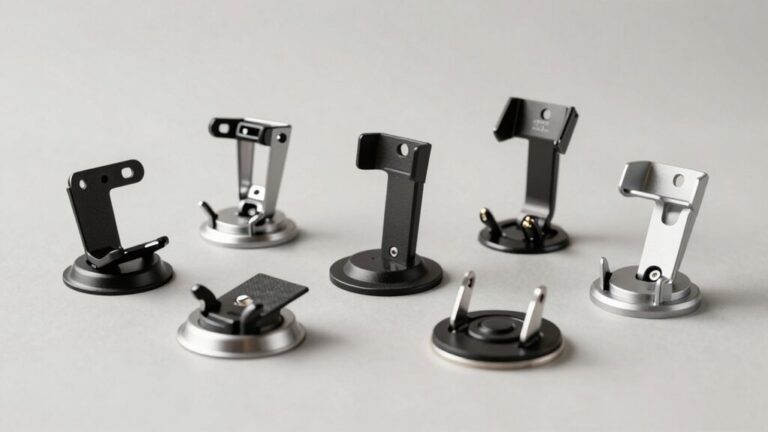
Before you can extract meaningful GPS data from your dash cam recordings, you’ll need to properly install the hardware components that capture this information. Select a central windshield location near the rearview mirror for ideal road coverage while ensuring the GPS antenna has clear sky access for satellite signal reception. Mounting techniques include adhesive pads or suction mounts on clean, dry surfaces with the lens facing straight ahead.
For power connections, utilize either the 12V cigarette lighter socket or hardwire directly to your vehicle’s fuse box using a hardwire kit with fuse tap adapters. Connect to both ACC and constant power sources for parking mode functionality, grounding the black wire to chassis metal. Route cables discreetly along windshield edges and A-pillars using trim removal tools and adhesive clips for professional aesthetics. Use Velcro fasteners for cable management to keep excess cable length organized and prevent loose wires from obstructing your view.
After installation, test the device by starting your car and verifying that it powers on automatically with the ignition to confirm proper electrical connections and GPS signal acquisition. Adjust the camera angle to ensure optimal coverage of the road ahead and eliminate blind spots in your recordings. Consider dash cams with Wide Dynamic Range technology to ensure clear footage in challenging lighting conditions such as tunnels, night driving, or direct sunlight. Many modern dash cams feature automatic incident detection that uses built-in sensors to identify sudden impacts or hard braking events and automatically save the relevant footage. When selecting a dash cam with GPS capabilities, ensure it includes parking mode recording to capture footage even when your vehicle is parked and the engine is off, providing enhanced security against break-ins and vandalism.
Practical Applications for Drivers and Fleet Managers
GPS-equipped dash cams transform incident documentation by recording precise telemetry alongside video footage, creating extensive evidence packages that reconstruct accidents with forensic accuracy. You’ll leverage synchronized location, speed, and timestamp data for incident reconstruction, establishing fault determinations and defending against fraudulent claims. Real-time alerts notify you of unsafe behaviors or collisions, enabling immediate intervention. The objective video evidence accelerates the claims process and reduces reliance on eyewitness testimony, making resolutions fairer and often quicker.
For fleet efficiency, you’ll utilize live tracking dashboards to monitor vehicle locations, routes, and operational metrics simultaneously. GPS data contextualizes driver behavior patterns, identifying risky zones and enabling targeted coaching interventions. You’ll optimize dispatching through real-time rerouting capabilities and reduce fuel costs by monitoring speed compliance and route adherence. Geofencing tracks job site duration and unauthorized zone access, while integrated telematics dashboards provide thorough fleet performance analytics for data-driven operational improvements. Advanced systems with cloud-based tracking enable remote monitoring of vehicle status and deliver driving and parking impact notifications directly to managers for immediate response. The combined monitoring system can also help reduce insurance premiums by providing carriers with documented proof of safe driving practices and rapid fault clarification. Understanding each driver’s perspective through combined video and GPS analysis reveals contextual factors that contribute to specific behaviors, allowing managers to deliver more effective and personalized coaching sessions. Modern dash cams leverage AI detection to identify distracted or risky driving behaviors and provide immediate visual and audio cues to drivers. Fleet operators must ensure drivers are informed about dash cam usage and comply with state-specific laws regarding audio recording consent and camera placement to maintain legal compliance.
Factors Affecting GPS Accuracy and Performance
Multiple interconnected variables determine your dash cam’s GPS accuracy, with satellite geometry serving as the foundation for positioning precision. Ideal configuration requires four or more satellites in varied positions to enable effective triangulation. Poor geometric distribution degrades positional quality regardless of signal strength.
Atmospheric conditions introduce systematic errors as signals traverse the ionosphere and troposphere. Temperature, humidity, and pressure variations distort signal propagation, while severe weather attenuates reception. Signal interference manifests through multipath effects—signals reflecting off buildings and terrain—particularly problematic in urban canyons and dense forests.
Physical obstructions such as tunnels, parking structures, and metallic window tinting block satellite line-of-sight. Vehicle-mounted electronics generate electromagnetic interference that degrades receiver performance. Your device’s hardware sensitivity, firmware currency, and update frequency directly impact real-time tracking precision and speed calculation accuracy. Positioning algorithms convert the satellite data into accurate location coordinates displayed on your dash cam. Advanced models with cloud backup capabilities can preserve GPS-tagged footage remotely, ensuring location data remains accessible even if the device is damaged or removed.
Choosing Between Built-In and External GPS Modules
When selecting a dash cam GPS solution, you’ll face a fundamental choice between integrated and modular architectures, each presenting distinct engineering trade-offs. Built-in GPS modules eliminate installation complexities through single-unit integration, reducing cable management and mounting requirements. However, their compact antennas and fixed positioning may compromise signal acquisition in vehicles with metalized glass or EMI-prone environments.
External GPS modules offer superior antenna performance through flexible placement optimization, improving satellite lock consistency and positional accuracy. This modular approach enables enhanced features including advanced trip logging and third-party cloud service integration. The trade-off involves increased installation complexity and component costs.
Your selection criteria should prioritize signal performance requirements against installation constraints. Built-in solutions favor simplicity and aesthetics, while external modules deliver measurable gains in GPS reliability under challenging reception conditions. GPS-enabled dash cams record current speed directly onto video footage, providing valuable data for accident documentation and traffic violation disputes.