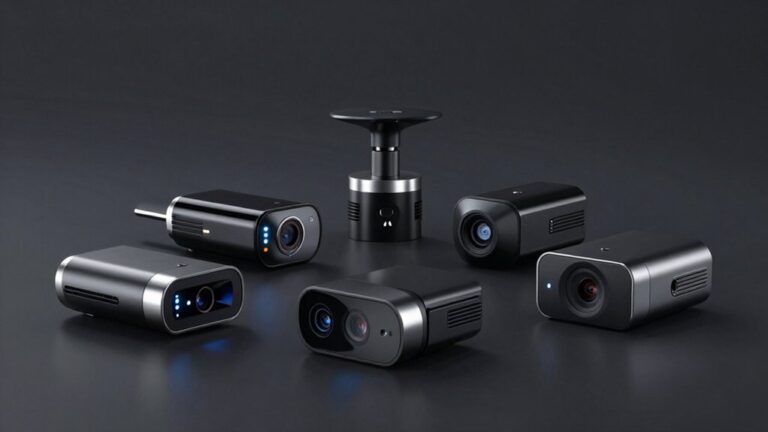

Your dash cam activates when your vehicle’s ignition sends 12V power to its input circuit, triggering the image sensor to capture continuous video through wide-angle optics while the processor encodes footage into 1-to-5-minute clips. Loop recording automatically overwrites oldest files when storage fills, but the integrated G-sensor detects impacts and locks critical footage to prevent deletion. GPS modules embed coordinates and timestamps into metadata streams, while motion detection enables parking surveillance. This thorough exploration reveals the complete operational architecture behind these systems.
Basic Recording and Loop Technology
Dash cams employ a continuous recording architecture that activates through the vehicle’s ignition circuit, drawing power from the 12V accessory or constant power rail via the cigarette lighter adapter or hardwired connection. You’ll configure basic settings to define recording intervals, typically segmented into 1-to-5-minute clips for optimized file management. Loop recording technology implements a first-in-first-out buffer system, automatically purging the oldest segments when storage capacity reaches threshold limits. This cyclical overwrite mechanism guarantees uninterrupted operation without manual intervention. However, inadequate memory storage can result in losing crucial footage if the card capacity is too small for your recording needs. The system maintains chronological file indexing on the micro SD card while preserving recently captured footage. To prevent premature card failures, regularly formatting the SD card in the dash cam itself rather than on a computer helps avoid corrupted files and logical errors. Visual or audible indicators confirm active recording status, allowing you to verify operational integrity. Advanced models feature incident recording modes that utilize built-in G-sensors to detect sudden motion changes, protecting critical footage from automatic deletion during the loop cycle. The emergency locking function prevents crucial accident recordings from being overwritten, ensuring that important evidence remains permanently saved until manually reviewed or transferred. The customization of segment length allows you to adjust recording intervals between 1 and 10 minutes to balance file size with your incident retention requirements. Premium dash cams like the BlackVue DR970X-2CH-PLUS II offer parking surveillance capabilities that continue monitoring your vehicle even when the ignition is off. This architecture assures continuous surveillance coverage throughout your drive cycle.
Camera Configurations and Mounting Locations
Modern implementations integrate the recording architecture with strategic camera placement and lens distribution across multiple monitoring zones. You’ll find single-channel units mount behind the rearview mirror, utilizing 120–150° wide-angle lenses for front-only coverage at 1080p to 4K resolution. Dual-channel configurations add rear camera placements connected via routed cabling, synchronizing both feeds to shared storage. Three-channel systems incorporate cabin-facing lenses alongside exterior sensors, enabling simultaneous interior and traffic monitoring—critical for fleet and rideshare applications. Triple-camera coverage provides comprehensive documentation by monitoring the front, rear, and interior of the vehicle simultaneously, capturing critical details that two-channel systems might miss. Mirror dash cams centralize all camera placements within the mirror housing, supporting picture-in-picture display of multiple feeds. Dual-facing windshield mounts combine forward and inward lens angles from a single housing, capturing both road conditions and driver behavior. Multi-channel arrays extend coverage to side panels and cargo areas, achieving complete 360° documentation across up to eight separate recording channels. Some advanced models feature 170-degree wide-angle lenses that provide broader coverage than standard configurations, expanding the field of view to capture more peripheral activity. Rear-mounted units install on the back window or near the license plate, providing dedicated backward surveillance that captures following vehicles and potential rear-end collision scenarios. High-end systems like those using the Sony IMX678 sensor deliver 4K front recording quality, ensuring detailed image capture for license plate recognition and incident documentation. Battery-powered dash cams with parking mode capabilities can record security footage even when the vehicle is parked and the engine is off, providing extended protection against vandalism and hit-and-run incidents. Premium models with 60fps frame rates capture smoother motion during high-speed driving scenarios, improving the clarity of fast-moving objects and license plates in the footage.
Essential Hardware Components
At the core of every dash cam lies an integrated system of optical, electronic, and storage components that transform raw light into protected video evidence. Your lens technology determines field of view (120°–170°) and aperture size for ideal light intake. Sensor quality, particularly Sony STARVIS CMOS variants, directly influences imaging performance in low-light conditions and supports video resolution from 1080p to 4K. Processor capabilities handle real-time encoding via H.264/H.265 codecs, enabling features like GPS integration and multi-channel recording. Storage options utilize microSD cards up to 256GB with segmented loop recording. Electrical components connect through 12V accessory outlets or hardwire kits for continuous operation. Power management systems prevent overheating while maintaining stable performance during extended recording sessions, ensuring reliable footage capture. Modern connectivity includes Bluetooth and Wi-Fi capabilities that enable wireless video transfer, live streaming, and smartphone app control for enhanced user convenience. For two-channel systems, the front camera powers the rear camera via a dedicated wire, streamlining the installation process. The G-sensor detects sudden impacts and automatically locks critical footage to prevent deletion during loop recording cycles. Advanced models incorporate AI motion detection that intelligently monitors activity during parking mode, enhancing security by triggering recording only when movement is detected near the vehicle. Budget-friendly options like the Wyze Cam series deliver 2.5K QHD video quality with excellent color night vision, offering cost-effective alternatives to traditional dash cam systems when properly wired into a vehicle’s power supply.
G-Sensor Impact Detection and File Protection
Beyond the optical and processing hardware that captures video, your dash cam’s accelerometer-based G-sensor performs continuous three-axis motion analysis to identify impact events requiring protected storage. Mounted on the main circuit board near the image sensor, this component monitors acceleration changes against calibrated thresholds to distinguish routine driving from collisions, hard braking, or sudden swerves. When preset force levels are exceeded, the sensor triggers automatic impact recognition, immediately flagging active recordings as critical incidents. The system then executes data preservation protocols by locking affected video files—typically including pre-event and post-impact footage—into protected storage partitions immune to loop recording overwrite cycles. You’ll find adjustable sensitivity settings allow threshold customization, preventing false triggers from minor bumps while ensuring genuine incidents generate immutable evidence files combining video, timestamps, GPS coordinates, and speed data for insurance and legal documentation. This protected footage serves as an unbiased witness that provides real-time evidence crucial for resolving disputes involving accidents, fraudulent insurance claims, or hit-and-run incidents. By capturing objective video evidence, dashcams help drivers refute staged accidents and false injury claims that are common in insurance fraud schemes. This automated documentation eliminates the need for manual recording activation during stressful collision scenarios, allowing drivers to focus on immediate safety concerns while the dashcam independently secures critical evidence. Advanced models may incorporate parking surveillance features that continue monitoring for impacts even when the vehicle is unattended, providing 24/7 protection against vandalism and parking lot incidents. To prevent battery depletion during extended parking mode operation, many systems include voltage cut-off settings that automatically disable the dash cam when the car battery reaches a minimum charge threshold. Once footage is captured, you can connect your smartphone to the dash cam via Wi-Fi to view, download, and share videos directly without removing the memory card.
GPS Integration and Location Tracking
Integrated GPS receivers in your dash cam establish satellite connections through dedicated chipsets that decode signals from multiple Global Navigation Satellite System (GNSS) constellations, calculating precise position coordinates through trilateration algorithms. Your device embeds latitude, longitude, velocity vectors, and UTC timestamps directly into video metadata streams, achieving GPS accuracy within 2.5 meters under ideal conditions. The chipset continuously logs position data at 1Hz or higher refresh rates, storing coordinates alongside H.264/H.265 encoded footage on removable SD cards or internal flash memory.
Cloud-connected systems transmit telemetry packets via cellular modems, enabling real-time fleet tracking dashboards. Your dash cam’s firmware processes geofencing alerts by comparing current coordinates against predefined polygon boundaries, triggering event recordings or push notifications when vehicles cross programmed zones. Advanced models combine GPS with G-sensors for detecting sudden deceleration or impacts, automatically saving footage during collision events. Premium dash cams with 4K resolution capture detailed video evidence while simultaneously recording precise GPS coordinates for each frame. Many GPS-enabled dash cams use supercapacitors instead of batteries to continue recording briefly after power loss while maintaining superior heat resistance and longevity in extreme vehicle temperatures. This location intelligence integrates with telematics platforms through standardized APIs. Fleet managers can check dash cam footage through integrated platforms like MyGeotab, which combines GPS tracking data with video management for comprehensive fleet oversight. The footage captured by these systems can help prove you were not at fault in accident scenarios, protecting your driving record and preventing wrongful liability claims. While basic plug-and-play dash cams are the most affordable to set up, professional installation for GPS-enabled models typically ensures proper hardwiring and optimal antenna placement for reliable satellite reception.
Wireless Connectivity and Mobile Access
Modern dash cams leverage wireless transceivers to establish bidirectional data links between your recording hardware and mobile devices, eliminating physical SD card removal for footage access. Wi-Fi modules operating on 5 GHz bands enable wireless transfer of high-resolution video files to smartphones through dedicated applications. Bluetooth 5.0 chipsets provide low-power connectivity for control functions and mobile notifications during critical events like collision detection or parking mode activation.
Cellular-equipped models integrate LTE modems for cloud uploads and real-time tracking, though subscription costs apply. You’ll access live streams, adjust recording parameters, and download footage remotely via companion apps. These applications facilitate firmware updates over-the-air and instant sharing with insurance providers. Wi-Fi-equipped dash cams create their own local hotspot network, allowing direct smartphone connection without requiring home or external internet access. Mobile apps also enable voice command functionality for hands-free operation and convenient control while driving. However, Wi-Fi range limitations restrict connectivity to several meters, while electromagnetic interference can disrupt signal integrity during data transmission. Despite wireless capabilities, most dash cams still require an SD card to record and store video footage locally, as they typically lack sufficient internal memory for continuous recording. Premium models may include built-in eMMC storage that eliminates the need for external memory cards and avoids common SD card reliability issues. Advanced companion apps offer features like AI-powered incident detection that automatically identifies and flags critical events such as collisions or sudden braking for priority review and cloud backup. Professional installation services ensure optimal wire routing and antenna placement for reliable wireless performance.
Cloud Storage and Remote Backup Options
Cloud storage systems in dash cams function through dedicated upload controllers that interface with onboard cellular modems or Wi-Fi transceivers to transmit recorded video data to remote servers. Your camera’s G-sensor flags event-triggered clips—collisions, hard braking, impacts—for priority upload via 4G/LTE or Wi-Fi connections. Subscription pricing typically starts at $9.99/month after trial periods, bundling features like 24/7 parking surveillance, live streaming, and unlimited retention. Cloud security employs end-to-end encryption and password-protected authentication protocols to prevent unauthorized access. Fleet operators leverage real-time monitoring for compliance and risk management, while individual drivers gain remote evidence retrieval for insurance claims. Users receive instant push notifications when their dash cam detects unusual events such as movement around the parked vehicle or emergency stops. Network interruptions can delay uploads, so internal storage fallback maintains local accessibility. High-quality models feature advanced G-sensor technology that ensures critical collision footage receives upload priority even during connectivity challenges. Evaluate provider reputation, data retention policies, and security standards before deployment.
Power Supply Options and Hardwiring
Your dash cam’s power delivery architecture determines recording reliability, with multiple supply pathways offering distinct trade-offs between installation complexity and functionality. The standard 12V accessory socket provides plug-and-play simplicity, activating with ignition cycles. However, hardwiring benefits include concealed cable routing, parking mode enablement, and voltage-regulated power delivery through fuse box integration. Hardwire kits incorporate low-voltage cutoff circuits preventing battery depletion below starting thresholds, typically 11.8V for lead-acid systems. Professional installation guarantees proper amperage matching—mirror cams often requiring 2.5A minimum. Alternative power solutions include OBD-II adapters offering diagnostics port connectivity and dedicated battery packs like Cellink NEO, which eliminate vehicle battery dependency entirely. USB ports provide convenience but frequently deliver insufficient current stability. Voltage monitoring modules within advanced hardwire kits enable user-configurable cutoff parameters, preserving electrical system integrity while maximizing surveillance coverage duration. Most cars feature switched accessory sockets that only supply power during engine operation, automatically controlling dash cam activation without manual intervention.
Parking Mode and Motion Detection
When your vehicle’s ignition circuit opens, parking mode-enabled dash cams shift into surveillance states governed by interrupt-driven firmware architectures. G-sensor accelerometers monitor threshold violations, triggering recording sequences upon impact detection. PIR-based motion detection features scan defined zones, initiating capture when thermal signatures cross sensitivity parameters. Buffered systems maintain circular write operations in volatile memory, preserving pre-event footage typically 5-30 seconds before trigger acknowledgment.
Time-lapse implementations compress temporal data through interval sampling, reducing bitrate demands while maintaining chronological continuity. Radar-assisted variants employ Doppler shift analysis to discriminate valid motion vectors from environmental noise. Parking mode efficiency directly correlates with standby current consumption—typically 30-150mA—and algorithmic precision in event classification. Advanced configurations integrate geofencing protocols via GPS coordinates and cloud-based notification frameworks, enabling remote surveillance through cellular or Wi-Fi data links. These systems provide round-the-clock protection against theft and vandalism even when the vehicle is unattended.
Advantages and Common Limitations
Beyond operational mechanics, dash cam implementations deliver measurable benefits constrained by inherent technical boundaries. You’ll gain objective accident documentation that reduces $300 billion annual U.S. insurance fraud through timestamped evidence. User behavior monitoring records speeding, harsh braking, and acceleration patterns, enabling driver coaching and fleet optimization. Insurance savings materialize through premium discounts when you install fraud-deterrent systems that lower claim frequencies. Motion-activated parking modes capture theft and vandalism evidence via triggered recording sequences. However, technical constraints include degraded recording quality under low-light conditions, storage limitations requiring loop recording protocols, and power dependency affecting continuous operation. Privacy concerns emerge with interior-facing sensors recording occupants. Camera angle restrictions and weather interference compromise footage reliability, requiring strategic mounting positions and lens specifications that meet environmental operating standards. High-definition capabilities provide enhanced video quality that captures critical details like license plates and road signs with superior clarity during incident reconstruction.