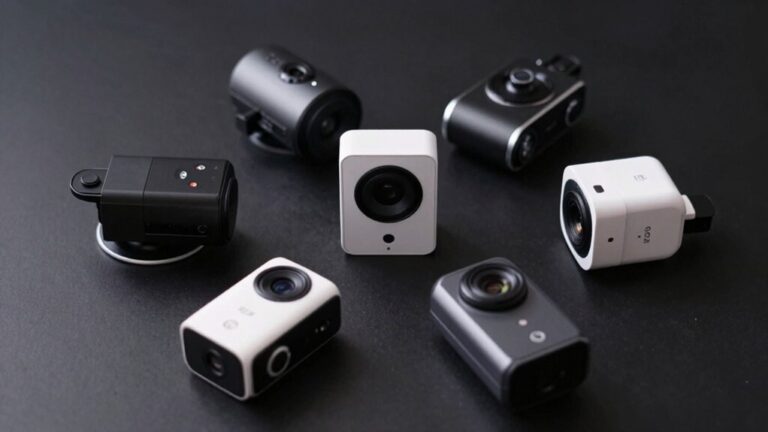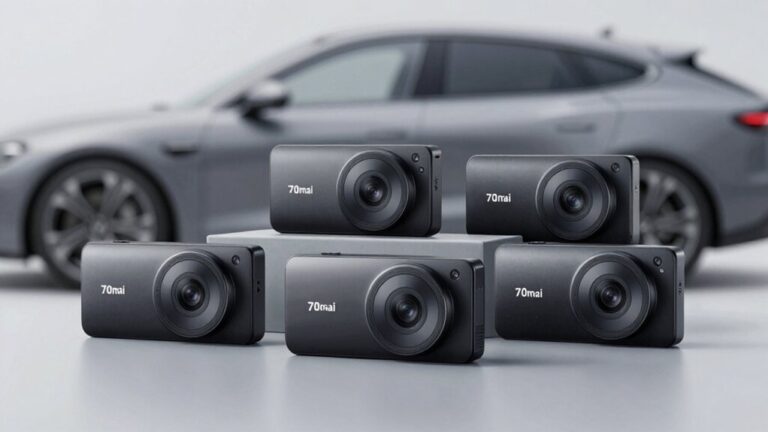

A good dash cam needs at least 1440p (2K) resolution paired with a wide dynamic range (WDR) sensor to capture license plates and facial details during critical incidents. You’ll want dual-camera coverage for front and rear monitoring, advanced night vision through Sony STARVIS sensors, reliable parking mode with impact detection, and GPS tracking for location verification. Look for high-endurance microSD cards (64GB minimum, UHS-3 rated), automatic loop recording with emergency file locking, and robust heat resistance for year-round reliability. The sections below break down each specification’s real-world impact on protecting your interests.
Resolution and Image Quality That Captures Critical Details
When evaluating dash cams, resolution and image quality directly determine whether your footage will successfully capture license plates, street signs, and facial features during vital incidents. Resolution comparisons reveal that 1080p struggles with distant details, while 2K/1440p offers balanced sharpness without excessive file sizes. 4K delivers superior detail for professional-grade evidence but demands considerably more storage and processing power.
However, resolution alone doesn’t guarantee quality. Image sensors like Sony Starvis provide essential image enhancement through improved light sensitivity and color contrast, particularly during low-light conditions. Compression algorithms affect final sharpness—aggressive compression can blur fine details despite high resolution. Higher frame rates (60fps versus 30fps) improve moving object clarity, while polarizing filters reduce windshield glare. Advanced systems now incorporate wide-angle views to capture adjacent lanes and roadside activity that narrow fields miss during critical incidents. Modern dash cams increasingly feature HDR technology to balance exposure in challenging lighting scenarios, from bright sunny days to shadowy parking structures. Multi-camera configurations enable 360-degree coverage that eliminates blind spots and provides comprehensive documentation of surrounding traffic conditions. For evidentiary purposes, 2K typically captures license plates at moderate distances, whereas 4K enables reliable identification when zooming footage. Premium models now incorporate 4K front cameras paired with lower-resolution rear units to balance comprehensive coverage with manageable storage requirements. The latest high-end models utilize Sony STARVIS 2 sensors for exceptional low-light performance that traditional sensors cannot match in challenging visibility conditions. The length of continuous recording depends on memory card size and video quality, with larger storage enabling more hours of video before loop recording overwrites the oldest files.
Camera Coverage Options for Complete Vehicle Monitoring
Sharp resolution proves worthless if your dash cam doesn’t capture the incident in the first place. Coverage architecture determines what events you’ll actually record.
Single front-facing camera types offer 120° to 170° field views but leave blind spots vulnerable. Dual-camera systems add rear coverage for collision documentation, while triple-unit configurations incorporate cabin monitoring—crucial for fleet operations and rideshare verification. 360-degree systems eliminate coverage gaps entirely through fisheye lenses or synchronized multi-camera arrays.
Field-of-view specifications require careful evaluation. While 210° diagonal FoV maximizes peripheral capture, wider angles introduce distortion and compromise license plate legibility at distance. Most professionals recommend 150° to 170° field views as ideal balance points between coverage breadth and forensic detail preservation. Premium models like the Vantrue E360 achieve seamless 360-degree footage through dual 210-degree lenses with 5.2K resolution for comprehensive incident documentation. Verify rear camera synchronization capabilities and mounting configurations to guarantee unobstructed sight lines across all installed units. Leading dual front and rear camera systems like the Viofo A329S and A329T series offer exceptional video quality with advanced features for complete road coverage. Advanced multiplexer systems can combine up to five cameras for comprehensive monitoring, though this approach typically reduces individual feed resolution compared to separate recording files. Models equipped with Sony STARVIS sensors deliver superior low-light performance, ensuring clear footage during night driving and adverse weather conditions. Most dash cams use loop recording to automatically overwrite the oldest footage once the memory card is full, ensuring continuous recording without manual intervention. Proper installation requires connecting power through your vehicle’s fuse box using a fuse tap compatible with your car’s fuse type to ensure safe, reliable operation without damaging original wiring.
Parking Mode and Surveillance Capabilities
How effectively can your dash cam protect your vehicle when you’re not behind the wheel? Parking mode surveillance activates recording through multiple trigger methods. Motion detection captures activity when movement occurs near your vehicle, while impact detection uses G-sensor technology to record collisions immediately. Time-lapse recording conserves power by capturing footage at reduced frame rates, though this compromises detail identification.
Radar parking mode offers superior range and efficiency, enabling monitoring for up to 40 days with auxiliary batteries. Hardwired installations with supercapacitors provide reliable power management across temperature extremes. High-resolution recording preserves essential evidence like license plates, while buffered recording saves pre-event footage for complete incident context. AI-powered sensors reduce false triggers, and GPS logging timestamps events accurately. Emergency recordings automatically lock video files to prevent overwriting during loop recording, ensuring critical incident footage is preserved. Dual-camera systems with front and rear recording provide comprehensive 360-degree coverage to capture incidents from all angles around your parked vehicle. Continuous monitoring capabilities help deter theft and hit-and-run incidents by maintaining surveillance even when the vehicle is unattended. Consider external battery packs to extend surveillance duration without depleting your vehicle’s primary battery. Modern hard-wiring kits include protective features that prevent car battery depletion during extended parking surveillance periods. These systems typically maintain a low-power standby state when inactive, dramatically reducing energy consumption while remaining ready to activate instantly when triggered. Professional installation ensures power cables are routed cleanly along the windshield and A-pillar trim for a discreet and tidy appearance.
Night Vision and Low-Light Performance
Your dash cam’s ability to capture clear footage deteriorates rapidly once daylight fades, making night vision technology essential for 24/7 protection. Advanced systems employ Sony STARVIS sensors (IMX323, IMX415, IMX678) with superior infrared sensitivity and noise reduction capabilities. Infrared night vision uses IR LEDs to illuminate pitch-black environments, though footage records in monochrome. Color night vision technology leverages HDR processing and sensitive sensors to maintain vivid detail in near-dark conditions, capturing critical evidence like traffic signals and vehicle colors. Wide Dynamic Range (WDR) balances overexposed headlights against shadow detail simultaneously. Low light performance improves substantially with 4K resolution, making license plates legible after dark. Models featuring Sony STARVIS sensors are particularly popular among vehicle enthusiasts for delivering excellent night vision in challenging lighting conditions. Premium dash cams with HDR support can capture clear footage in both day and night conditions, significantly improving overall video quality. Dual-mode cameras combining IR and color technologies optimize evidence collection across varying lighting conditions, from well-lit urban streets to rural darkness. Multi-channel dash cams with infrared cabin cameras provide comprehensive interior monitoring alongside exterior recording, making them particularly valuable for rideshare drivers and fleet operators. These low-light sensitive sensors amplify limited ambient light to produce clearer images without relying solely on infrared illumination. The latest STARVIS 2 sensors offer even greater sensitivity and noise reduction compared to first-generation models, enabling clearer nighttime footage in extremely dark environments. Loop recording features ensure continuous capture without the need for manual deletion of older footage.
Storage Solutions and Loop Recording
Capturing crisp footage in darkness means nothing if your dash cam can’t store it reliably. You’ll need a high-endurance microSD card with minimum 64GB capacity, though 128GB or 256GB better suits extended recording. For 4K resolution, consider 256GB to 512GB—the latter stores up to 36 hours of 4K footage. Card speed matters critically; select UHS Speed Class 3 (V30) rated cards to prevent recording interruptions during high-bitrate capture. Endurance-rated options like the SanDisk High Endurance or Samsung Pro Endurance handle continuous recording without data corruption, making them ideal for dash cam applications. These cards are engineered to withstand extreme temperatures, water, and shocks that standard consumer-grade memory cards cannot endure.
Loop recording automatically overwrites oldest footage when storage fills, eliminating manual management. Configure loop intervals between 1-5 minutes to balance file size with event retrieval efficiency. Many dash cams feature collision detection that automatically locks important files to prevent them from being overwritten during loop recording. Cloud storage types offer remote access and protection against physical damage, though they typically require subscriptions. Real-time cloud storage enhances security by instantly uploading critical incidents to remote servers, ensuring footage remains accessible even if the camera is damaged or stolen. Dual-channel systems demand faster cards and larger capacities due to simultaneous multi-stream recording from front, rear, and interior cameras. Some dash cams have maximum card size limits, so always verify your device’s compatibility before purchasing higher-capacity storage. To maintain optimal performance and prevent file corruption, format your SD card every 2 to 4 weeks, with weekly formatting recommended for heavy users like rideshare drivers.
Connectivity Features for Remote Access and Cloud Backup
Modern dash cams transcend basic recording through connectivity features that transform them into networked security systems. Cloud connectivity enables 24/7 monitoring through smartphone apps, delivering live video streaming with latency ranging from under 4 seconds to over one minute depending on the model. LTE cellular modules provide real-time data transmission beyond Wi-Fi range, supporting critical features like SOS alerts and remote live view.
Remote access allows you to view, download, and share recorded footage without removing SD cards, streamlining evidence management. Automatic cloud backup prevents footage loss from memory card failure while offering virtually unlimited storage capacity compared to local microSD cards. Advanced models employ end-to-end encryption to protect your data. These systems send instant notifications for disturbances or collisions directly to your smartphone, alerting you to potential security events as they occur. When a dash cam’s G-sensor detects a crash or sudden movement, it automatically saves and uploads the footage to the cloud, ensuring the video remains safe even if the device is damaged or stolen. Beyond immediate safety benefits, dash cam footage can help protect your driving record by providing evidence when you’re not at fault, potentially preventing premium increases. Most systems require monthly LTE subscription plans for cellular connectivity features. For permanent installations, hardwire kits can connect to your vehicle’s fuse box or OBD-II port to support parking mode and battery voltage monitoring. To prevent battery drain during parking mode, look for systems with low voltage protection that automatically shut off before depleting your car’s battery. Many compact models prioritize wireless connectivity to maintain a discreet installation behind the rearview mirror while still providing full remote access capabilities.
GPS Tracking and Location Data
While basic dash cams simply record video, GPS-enabled models embed precise location coordinates, speed data, and timestamps directly into your footage as metadata. This enables precise incident reconstruction for insurance claims and legal disputes. GPS accuracy depends on receiver quality, with professional-grade modules delivering reliable location analytics. For fleet applications, GPS tracking supports fleet optimization through route analysis and driver accountability systems. Advanced models offer real-time monitoring with geo-fencing alerts when vehicles enter or exit designated zones. Trip logging capabilities provide thorough driving records accessible via companion apps. You’ll benefit from speed-based alerts that enhance safety monitoring. Systems with automatic cloud upload enable immediate access to dashcam footage and location data from any connected device. Consider storage capacity carefully—continuous GPS logging combined with dual-camera footage requires substantial SD card space or cloud backup solutions for effective data retention.
Power Options and Heat Resistance
Your dash cam’s power system directly influences its operational reliability, particularly in extreme temperature environments where heat buildup poses considerable risks to electronic components. When evaluating power sources, you’ll find supercapacitors demonstrate superior heat resilience compared to lithium-ion batteries, maintaining consistent performance across extreme temperature ranges while delivering markedly longer lifespans through increased charge/discharge cycles. Battery-powered units offer extended parking surveillance capabilities without hardwiring requirements but experience accelerated degradation under sustained high-heat exposure.
For parking mode optimization, impact detection consumes minimal power (<0.01 watts) versus motion detection modes (0.6-0.99 watts), reducing thermal stress during stationary operation. Hardwire kits with voltage cut-off protection prevent vehicle battery depletion while enabling continuous monitoring. External battery packs (7,500-12,000 mAh) provide autonomous power without taxing your vehicle’s electrical system. Supercapacitors store energy electrostatically rather than chemically, allowing them to withstand hundreds of thousands to millions of charge cycles without significant capacity loss.
Crash Detection and Emergency File Protection
G-sensor technology forms the foundation of crash detection systems, employing tri-axial accelerometers that measure force across X, Y, and Z axes to identify sudden deceleration events, collisions, and impact intensities typically exceeding 0.5-3.0 G-forces depending on your configured sensitivity threshold. Upon detecting an impact, the system automatically locks relevant footage in protected directories, preventing overwrite during continuous loop recording cycles. Pre-event buffering captures 15-30 seconds before collision occurrence, providing essential context for incident reconstruction. Advanced models integrate parking mode crash detection, activating recording when your stationary vehicle experiences jarring or impacts, with segregated emergency protection protocols safeguarding files from deletion. All cameras require hardwiring for parking modes to function properly during extended periods when the vehicle is unattended. Real-world performance varies noticeably—sensor trigger latency, mounting robustness, and power integration directly influence footage completeness during actual collision events, necessitating careful model selection based on verified testing data.
Smart Alerts and Driver Assistance Features
Modern dash cameras leverage artificial intelligence and sensor arrays to deliver real-time smart notifications that warn you of developing hazards before they escalate into collision scenarios. These AI capabilities differentiate between benign environmental movements and legitimate threats through custom-trained algorithms, reducing false alerts while maintaining vigilant monitoring.
Advanced models integrate GPS-based warnings for speed cameras, red light intersections, and dynamic speed limit changes. Lane departure detection and tailgating proximity alerts utilize spatial awareness sensors to maintain safe driving parameters. Voice-activated controls enable hands-free operation, while forward collision warnings notify you when traffic ahead begins moving—essential for stop-and-go conditions.
Paired smartphone applications deliver instant notifications during parking mode, detecting impacts or suspicious movement around your unattended vehicle. Cloud-connected systems provide remote live-view access and customizable alert prioritization based on threat severity. Fleet dash cams employ AI-powered detection to identify risky driving behaviors and implement proactive safety measures across commercial vehicle operations.