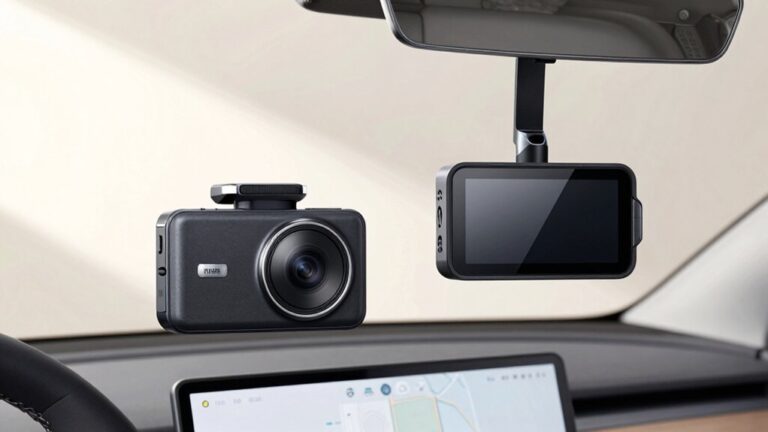

Your dash cam’s HDR captures three consecutive frames at different exposure levels—underexposed, correctly exposed, and overexposed—within milliseconds by rapidly adjusting shutter speed. The dedicated image signal processor then employs pixel-level alignment algorithms to merge these frames, combining highlight details from underexposed shots with shadow information from overexposed ones. This multi-exposure bracketing delivers up to 42% better license plate readability at night and 35% improved performance in backlit conditions. Understanding the technical differences between HDR and WDR processing reveals how these systems handle rapidly changing lighting environments.
What Is HDR Technology in Dash Cams?
The HDR benefits include up to 42% improved license plate readability at night and 35% better performance in backlit conditions. Modern dash cam advancements leverage software algorithms that analyze each pixel’s luminance value, automatically adjusting contrast and color accuracy. You’ll capture road signs, pedestrians, and critical evidence with superior clarity during high-contrast scenarios like dawn driving or sudden shifts between bright and shadowed areas. HDR technology merges multiple exposures of the same scene to preserve details from the darkest to brightest areas of an image. Premium models like those featuring Sony Starvis sensors deliver exceptional HDR performance for both daytime and nighttime recording. Advanced cameras equipped with wide dynamic range technology excel at handling challenging lighting transitions, from tunnel exits to oncoming headlights. These advanced image processing algorithms work alongside other technologies like WDR to enhance brightness, contrast, and clarity while reducing noise and graininess in your footage. Top-tier dash cams with 4K 60fps quality combine HDR processing with high frame rates to capture smooth, detailed footage in challenging lighting conditions. High-end models with 4K or higher resolution provide superior detail capture that complements HDR processing for maximum image clarity.
How HDR Captures Multiple Exposures
HDR technology achieves its superior dynamic range through exposure bracketing, a process where your dash cam’s image sensor captures multiple frames at different exposure values within milliseconds. The sensor rapidly adjusts shutter speed—not aperture—to maintain consistent depth of field across exposures. Typically, three frames are captured: one underexposed for highlight preservation, one correctly exposed for midtones, and one overexposed for shadow detail recovery.
Advanced dash cam processors employ dynamic range optimization by fusing these exposures through algorithmic alignment and blending. The system combines highlight data from underexposed frames with shadow information from overexposed shots, creating a composite image that exceeds the sensor’s native capabilities. This process relies on the HDR operator’s judgment to balance the fusion of tonal information from each exposure level. This multi-exposure approach substantially outperforms single-exposure processing, delivering superior detail retention in high-contrast driving scenarios like tunnels, direct sunlight, and nighttime conditions. While HDR processing handles exposure variations internally, pairing it with a polarizing filter can further reduce windshield and dashboard reflections that HDR alone cannot eliminate. Many modern dashcams offering Full HD 1080p recording effectively implement HDR technology to enhance image quality without requiring 2K or 4K resolution. When installing your dash cam, ensure proper mounting location compliance to avoid obstructing your view while maximizing HDR capture effectiveness. For optimal coverage, consider models with dual-camera setups that apply HDR processing to both front and rear recording simultaneously. Modern wireless dash cams leverage seamless connectivity to instantly transfer HDR-enhanced footage to your smartphone for real-time review and cloud backup.
The Image Merging Process Explained
Once your dash cam’s sensor completes exposure bracketing, its dedicated image signal processor (ISP) initiates the merging sequence by loading the captured frames into on-chip buffer memory for preprocessing. Image alignment algorithms correct micro-shifts between exposures using phase correlation or feature matching, ensuring pixel-level correspondence essential for ghosting prevention. The ISP then performs detail extraction, pulling shadow information from overexposed frames where darker regions retain granular data, while simultaneously harvesting highlight detail from underexposed captures that preserve bright areas without clipping. Weighted pixel-wise fusion combines these tonal zones through computational averaging, prioritizing best exposed values. Advanced firmware implements deghosting routines to suppress motion artifacts from moving vehicles or objects. This automated process captures a wider range of luminance information than single-exposure photography, allowing dash cams to record both bright skies and shadowed road details simultaneously. Premium models like the DDPAI Z50 Pro leverage 4K HDR front cameras to deliver exceptionally detailed footage across varied lighting conditions. The Viofo A329S/A329T series also excels with triple channel recording capability that applies HDR processing across front, interior, and rear cameras simultaneously. The resulting radiance map undergoes tone mapping via gamma curves and local contrast operators, compressing the wide dynamic range into displayable output suited for your screen or storage codec. High-quality HDR footage with sufficient clarity can prove invaluable in traffic accident cases where lighting conditions might otherwise obscure critical details. To maintain continuous HDR recording during extended parking surveillance, many users pair their dash cams with battery packs that provide hours of uninterrupted power without draining the vehicle’s main battery. Models equipped with supercapacitors offer superior heat resistance and longevity compared to lithium-ion battery alternatives, though they require hardwired connections to maintain parking mode functionality.
HDR Vs WDR: Key Technical Differences
While both technologies enhance dynamic range in dash cam imaging, their underlying architectures differ fundamentally at the signal processing level. WDR operates through single-frame capture with hardware-integrated tone-mapping circuits, delivering real-time image optimization without frame buffering delays. You’ll find WDR advantages in rapidly changing lighting conditions where its instantaneous processing prevents motion artifacts. Conversely, HDR employs multi-exposure bracketing with digital frame fusion algorithms, requiring sequential capture at varied shutter speeds. This multi-frame dependency creates HDR limitations: potential ghosting artifacts when recording fast-moving vehicles and increased CPU overhead for real-time merging operations. WDR’s hardware-centric approach maintains consistent frame rates, while HDR’s software-dependent processing demands higher computational resources. Your sensor’s dB rating directly impacts WDR ceiling performance, whereas HDR’s dynamic range scales with exposure bracket count and merging algorithm efficiency. HDR enhances brightness and color accuracy through advanced digital processing techniques that combine multiple frames. Modern 4K resolution cameras leverage HDR imaging to capture fine details in both shadowed and brightly lit areas, making them essential for comprehensive incident recording. The Rexing Dash Cam V1 demonstrates effective WDR technology implementation with its wide 170-degree lens, delivering reliable performance across varying lighting scenarios. Advanced dash cams like the Nextbase 522GW feature rotating polarizing filters that work alongside HDR to further reduce windshield glare and reflections in challenging lighting environments.
Handling Challenging Lighting Scenarios
Challenging lighting scenarios expose the critical differences between your dash cam’s sensor bit depth and its dynamic range processing capabilities. When you’re shifting from tunnel darkness to direct sunlight, HDR executes rapid exposure adjustments across multiple image captures—typically three frames at different EV values. The processor fuses these exposures using tone-mapping algorithms that preserve highlight detail in 255 RGB zones while recovering shadow information from underexposed frames. Your camera’s ability to handle lighting dynamics depends on sensor response time and buffer speed during simultaneous captures. HDR prevents clipping in bright regions (overexposure beyond sensor saturation) and maintains license plate readability against headlight glare through selective exposure blending. Advanced implementations utilize gamma curve optimization to smooth shifts between extreme luminance values without introducing halo artifacts or motion blur. This software-based processing distinguishes HDR from hardware-dependent contrast management systems that rely solely on sensor adjustments. The combination of HDR and specialized sensors allows modern dash cams to balance contrasts between bright headlights and dark shadows, ensuring clear license plate captures even during dusk or in poorly lit parking lots. Dash cams equipped with Sony STARVIS sensors particularly excel in these conditions due to their superior night vision and effective noise reduction capabilities. Modern implementations like DOL-HDR 2.0 further enhance dynamic range performance by improving the capture of critical details across varying lighting conditions. To maximize HDR performance during extended recording sessions, enabling voltage cut-off settings helps prevent battery drain while maintaining optimal dash cam operation.
Hardware and Sensor Integration
The rapid exposure adjustments that enable HDR’s lighting adaptation exist only because specific hardware components execute these operations at the silicon level. Your dash cam’s sensor performance depends on CMOS technology—specifically Sony STARVIS 2 models like IMX585, IMX662, IMX664, IMX675, and IMX678. These sensors employ Clear HDR function, capturing dual frames with different exposure parameters simultaneously, eliminating motion artifacts. The System-on-Chip processors from Novatek, Ambarella, or HiSilicon handle computational demands, with Quad-Core ARM Cortex A53 architectures enabling 4K 60FPS recording. Processor efficiency determines whether HDR functions operate through dedicated hardware pathways rather than software emulation. This silicon-level implementation expands dynamic range measurement in decibels, differentiating between extreme light and dark spectrum values while maintaining thermal stability during extended recording sessions. Premium glass lens elements with anti-reflective coatings further enhance HDR performance by reducing glare and improving light transmission to the sensor. Modern dash cams featuring STARVIS 2 sensors deliver exceptional low-light sensitivity that complements HDR imaging by capturing greater detail in shadowed areas and bright highlights simultaneously. The Viofo A229 Pro exemplifies this technology integration with its exceptional 4K front video quality and advanced HDR implementation that ensures license plate legibility even in challenging lighting conditions. Some manufacturers now incorporate FlowState stabilization to complement HDR functionality, reducing camera shake while maintaining the expanded dynamic range necessary for capturing smooth, detailed footage during sudden vehicle movements or rough road conditions. The Viofo A329 pushes these capabilities further with 4K 60fps recording on the front camera, combining high frame rates with HDR processing to capture smooth, detailed footage in rapidly changing lighting scenarios. The Alpine DVR-C320R leverages wide dynamic range technology alongside its 1080p HD dual-camera system to provide reliable front and rear coverage that adapts to varying lighting conditions throughout the day.
Real-World Performance Benefits
Beyond silicon implementation, HDR technology delivers measurable performance advantages across driving scenarios where standard sensors fail. You’ll capture license plates 42% more clearly at night through multi-exposure frame merging that eliminates headlight glare while preserving shadow detail. Real world examples demonstrate HDR’s superiority during tunnel passages—exposure algorithms prevent the blackouts and washouts that render non-HDR footage unusable. User testimonials consistently highlight improved evidence quality during dawn, dusk, and overcast conditions where contrast extremes challenge single-exposure sensors. Hardware-based HDR implementations reduce motion blur by combining rapid sequential captures without sacrificing frame rate. The result: sharper moving object rendering, enhanced character discernibility on signs and plates, and reduced noise across the luminance spectrum—transforming your dash cam into a reliable legal documentation tool regardless of lighting conditions. Proper camera positioning centered on your windshield with a slight downward angle ensures optimal HDR performance across all recording scenarios.
License Plate and Detail Capture Capabilities
License plate legibility hinges on your dash cam’s ability to resolve alphanumeric characters across luminance extremes—a challenge HDR technology addresses through multi-exposure pixel-level processing. Sony STARVIS sensors execute DOL HDR by capturing underexposed frames for bright regions and overexposed frames for overexposed frames for dark zones, then merging them to maintain character definition. You’ll find this superior to WDR’s single-frame dynamic adjustment. Telephoto units like VIOFO’s RTC420 integrate 4x optical zoom with HDR, delivering distortion-free capture clarity at 20-meter distances. Vantrue’s PlatePix™ augments this through AI-driven region detection, applying selective sharpening and denoising to license plate segments. When paired with 4K resolution sensors, HDR increases pixel density sufficiently to resolve fine character strokes even during motion, ensuring forensic-grade documentation. The technology minimizes image noise for clearer license plate recordings in challenging lighting scenarios. Clear license plate documentation proves especially valuable when establishing liability in accident cases, as it provides objective identification of vehicles involved in traffic violations or crashes. Modern dash cams also incorporate Lane Departure Warning systems that utilize forward-facing cameras to monitor vehicle positioning within lane markings, adding an extra layer of safety alongside HDR’s documentation capabilities. Premium models with dual channel configurations capture both front and rear perspectives simultaneously, ensuring comprehensive vehicle protection during incidents.