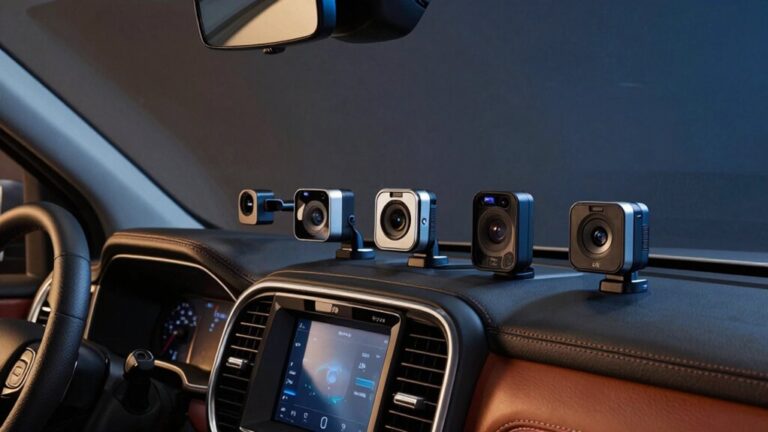

Impact detection uses a built-in G-sensor to monitor three-axis acceleration forces in your dash cam, automatically triggering recording and locking footage when impacts exceed preset thresholds—typically ±2g to ±16g. When your vehicle experiences sudden force from collisions, hard braking, or parking-lot incidents, the system captures pre-impact, impact, and post-impact sequences within 1-18 seconds depending on your model. This protected footage can’t be overwritten during loop recording, ensuring you’ll preserve critical evidence for insurance claims. Understanding response times, sensitivity calibration, and parking mode capabilities will help you maximize your dash cam’s protective functions.
Understanding Impact Detection and G-Sensor Technology
Impact detection systems serve as the critical safeguard in modern dash cameras, automatically identifying and responding to sudden force changes that indicate collisions, vandalism, or theft attempts. At their core, G-sensors—accelerometers that measure force—differentiate between normal driving maneuvers and collision-level impacts. When forces exceed preset thresholds, these sensors trigger instant recording and protect footage from deletion.
Impact sensitivity varies considerably across dash cam models, directly affecting evidence quality. You’ll find customizable G sensor calibration options in advanced systems, allowing threshold adjustments to match your driving style and environmental conditions. This calibration guarantees the dash cam responds appropriately to genuine incidents while minimizing false triggers from road bumps or aggressive cornering. The locked video file feature ensures that critical footage surrounding accidents remains preserved and won’t be overwritten during the camera’s normal loop recording cycle. Wake-up time differs significantly between models, with some cameras activating within one second while others may take over ten seconds to begin recording. Advanced features like buffered parking mode can record moments before an impact, providing a fuller context of events. Modern dash cams equipped with machine vision capabilities can further enhance detection accuracy by combining G-sensor data with AI-powered visual analysis of potential collision scenarios. Some advanced models now integrate voice control functionality that allows drivers to manually save footage or adjust settings hands-free using simple voice commands when an incident occurs. The objective video evidence captured by dash cams during detected impacts can accelerate insurance claims by helping prove fault and protecting drivers from fraudulent claims. Proper sensitivity configuration optimizes both security coverage and storage efficiency.
How Impact Detection Works in Real-Time Scenarios
When your vehicle experiences a collision or significant shock, the dash cam’s G-sensor measures acceleration forces across three axes—typically within a range of ±2g to ±16g—and compares these readings against programmed thresholds in milliseconds. Upon detecting impact, the system exits standby mode and initiates recording, capturing 30-second clips encompassing pre-impact, impact, and post-impact sequences. Real time alerts transmit immediately to your smartphone, enabling remote monitoring and live footage access. The device increases current draw up to 11 times normal consumption to power simultaneous recording and notification functions. For evidence preservation, impact-triggered files are automatically segregated into protected folders, preventing overwrite during loop recording cycles. The incident lock feature marks these recordings as important, safeguarding them from deletion and ensuring critical events remain retrievable for later review. This preserved footage can help prove you were not at fault in accidents, potentially preventing premium increases and protecting your driving record from wrongful liability claims. Most insurance companies will accept dash cam footage during the claims process, particularly when liability is disputed, as it provides objective, time-stamped evidence of how an accident occurred. The unbiased witness perspective provided by dash cam recordings is especially valuable when facing fraudulent insurance claims or resolving disputes where multiple parties offer conflicting accounts of what transpired. For continuous operation during parking mode, hardwiring your dash cam to an ACC fuse allows the device to monitor and record impacts even when the vehicle is off. To ensure optimal dash cam performance and secure mounting that withstands impact forces, many vehicle owners opt for professional installation services that customize the setup with proper wiring and positioning. Wake-up times vary between 9 to 18 seconds across models, potentially affecting incident documentation completeness.
Impact Detection Response Times Across Different Models
Among dash cam models, response time performance varies dramatically, with measurable differences ranging from 1 second to 18 seconds following impact detection. This impact response comparison reveals critical distinctions: Thinkware U3000 leads at 1 second, while Vueroid D21 consistently delivers 2-second activation. IROAD X10 Pro and Thinkware F790 respond within 3 seconds, whereas Fine Vu GX 33 requires 4 seconds. Budget models like Red Tiger F77 lag considerably at 9-18 seconds, compromising evidentiary capture.
These dash cam advancements correlate directly with power consumption and hardware architecture. Models achieving sub-3-second response typically draw 110-121 milliamps during parking mode, compared to power-saving alternatives consuming just 10 milliamps. You’ll find dedicated impact-triggered wake-up features deliver superior performance over motion-detection or time-lapse alternatives, making response time specifications essential evaluation criteria. The Vantrue N4 Pro demonstrates this trade-off, reducing wake-up time from 12-13 seconds to 6 seconds by increasing current draw from 10 to 110 milliamps. Fleet-oriented solutions like Surfsight AI-12 and AI-14 integrate real-time driver alerts through visual and audio cues to complement impact detection with proactive risk prevention capabilities.
Impact Detection in Parking Mode for Vehicle Security
G-sensor technology transforms your parked vehicle into an autonomous surveillance system, continuously monitoring for physical disturbances through tri-axial accelerometer arrays calibrated to detect force vectors exceeding preset thresholds. When impacts occur, the system locks pre-buffered and post-event footage into protected files, preventing loop recording overwrites. Impact detection benefits include capturing hit-and-run evidence, documenting parking lot collisions, and supporting insurance claims with timestamped video proof—all without manual intervention. Claims containing dash cam video are resolved 50% faster than those without recorded evidence.
However, parking mode challenges persist. False positives from door closings or environmental vibrations can drain power reserves and create redundant files. You’ll need external hardwiring solutions to maintain 24/7 monitoring, as battery constraints limit operational duration. Sensitivity calibration becomes critical; threshold settings must balance capturing legitimate impacts while filtering benign disturbances to optimize storage efficiency and recording accuracy. Proper storage selection is equally important, as endurance-class microSD cards in USB adapters offer the reliability needed to withstand continuous recording cycles without data corruption. Advanced dashcams support event pre-buffering to capture footage seconds before an incident occurs, ensuring complete documentation of parking collisions. Modern dual-channel dash cams provide both front and rear coverage, ensuring comprehensive surveillance of your entire vehicle perimeter during parking mode. The Garmin Drive app enables wireless management of recorded footage across compatible devices, allowing you to review impact-triggered videos and adjust camera settings remotely. Unlike continuous recording systems, event recording mode saves only short video segments around detected incidents, typically in 3-minute clips that preserve critical evidence while minimizing data storage requirements.
Impact Detection vs. Motion Detection: Key Differences
While both technologies serve protective functions in modern dash cameras, impact detection and motion detection operate through fundamentally different mechanisms that determine when and how your device captures footage. Impact detection advantages include G-sensor activation upon physical shock, automatic event locking to prevent overwriting, and superior performance capturing collisions and hit-and-runs with minimal false positives. Motion detection limitations emerge through optical or radar sensors that trigger on any surrounding movement, generating intermittent clips rather than continuous recording. You’ll encounter more false alerts from pedestrians, animals, and weather conditions, requiring extensive video review. Motion detection consumes higher power due to continuous sensor operation, while impact detection remains dormant until triggered. Impact detection records before and after incidents by saving video segments that include footage from moments leading up to the triggering event. Modern dash cam systems may integrate ADAS features like forward collision warnings and lane departure alerts to provide real-time safety notifications beyond basic recording functions. Combined modes optimize coverage by allowing impact detection to override motion sensing during critical events. Dash cams with Parking Mode enabled can utilize both detection methods when the vehicle is off, entering a low-power standby state to provide surveillance while conserving battery life. The visible presence of a dash cam can also deter thieves and vandals who are less likely to target a vehicle they know is being recorded. Emergency recording can also often be manually triggered by a button, voice command, or remote control, allowing the driver to save important footage instantly. Storage requirements vary based on recording resolution, with 128GB or larger cards recommended for higher quality footage or extended recording durations.
Power Consumption and Performance Trade-offs
Impact detection systems deliver protection, but their effectiveness depends on carefully balancing power consumption against performance capabilities. You’ll find that typical dash cams draw 250–500 mA in parking mode, while advanced low-power models consume as little as 2 mA—a difference that greatly affects battery longevity.
High sensitivity continuous monitoring improves crash detection accuracy but accelerates battery drain without proper power management. Conversely, reduced power draw extends surveillance duration yet may delay detection of minor impacts due to less frequent sensor wake-ups.
Energy efficiency techniques include lowering resolution during parking mode, disabling Wi-Fi and GPS, and implementing voltage cut-off hardware. Intelligent parking modes can reduce consumption to one-third of standard recording levels. You’ll need hardwired installations with low-voltage protection to optimize long-term parking surveillance without risking battery depletion. Battery packs integrated with hardwiring kits can further reduce reliance on the car’s battery, ensuring longevity and safety. When impact events are detected, loop recording can be temporarily suspended to protect critical footage from being overwritten by new recordings. For those seeking to avoid hardwiring altogether, external battery packs can power dual-channel systems for extended hours while maintaining reliable 24/7 surveillance. Smart power adapters that tap into your rearview mirror’s power source offer plug-and-play installation alternatives that eliminate the need for permanent modifications to your vehicle’s electrical system. Dedicated battery packs with overheating protection and overcharging safeguards provide safe extended power during parking surveillance without risking damage to your equipment. Dash cams relying on cigarette lighter outlets typically shut off when the engine turns off, which is why hardwire kits connecting to the fuse box are necessary for continuous parking mode operation.