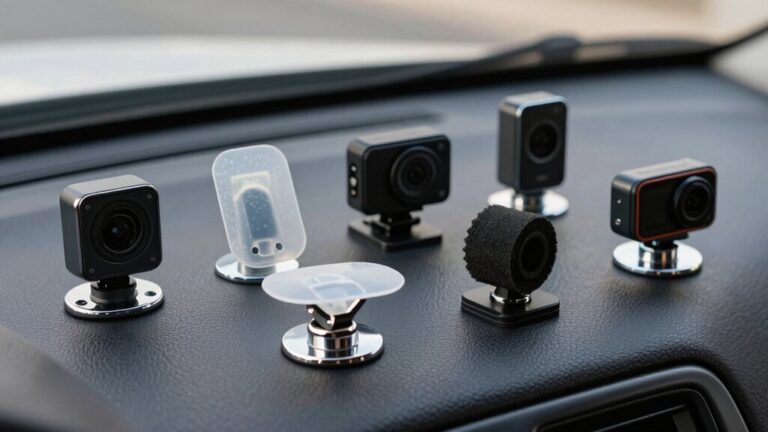

Your dash cam’s capacitor stores electrical energy through an electrostatic field created between two conductive plates separated by dielectric material. Unlike batteries that rely on chemical reactions, this design allows instantaneous charging and discharging using the formula Q = C × V. The supercapacitor variant delivers rapid power bursts while withstanding extreme temperatures from -40°C to +85°C and over 500,000 charge-discharge cycles. It provides immediate power during shutdowns, preventing file corruption while eliminating thermal runaway risks. The complete technical specifications and installation requirements below explain ideal implementation.
Understanding the Basic Operating Principle of Dash Cam Capacitors
When voltage is applied across a dash cam capacitor, two conductive plates separated by a dielectric material accumulate opposite electrical charges, creating an electric field that stores energy without chemical reactions. This fundamental structure defines all capacitor types, though supercapacitors used in dash cams achieve substantially higher charge capacity through enhanced plate surface area and specialized dielectrics. The charge stored follows the equation Q = C × V, where capacitance and applied voltage directly determine total charge capacity. Unlike batteries, capacitors don’t sustain current flow—they build voltage across the dielectric barrier until fully charged. When the dash cam draws power, the stored electric field discharges rapidly, delivering energy instantaneously to maintain circuit operation during power interruptions or vehicle shutdown sequences. This rapid energy discharge enables supercapacitors to preserve last video files before the dash cam completely shuts down during power loss. The ability to capture and save footage during unexpected power loss is critical, as this real-time record can provide objective evidence of events leading up to and during an accident. Some advanced dash cams utilize this capacitor-powered reserve to support buffered recording functionality, which temporarily stores footage in a short loop so that video from just before a power loss event can be saved. For extended recording during parking mode, users can integrate hardwire kits that connect to the vehicle’s fuse box, enabling the dash cam to operate while parked without relying solely on capacitor reserves. These installations typically include a voltage cut-off feature to prevent excessive battery drain when the vehicle is parked and unattended. The heat-resistant properties of supercapacitors make them particularly suitable for dash cam applications, as they can withstand the extreme temperatures inside vehicles without degrading as quickly as lithium-ion batteries.
Energy Storage Mechanisms: Electric Fields vs. Chemical Reactions
Understanding how your dash cam maintains power during ignition cycles requires examining the fundamental distinction between capacitive and battery-based energy storage. Your dash cam’s capacitor stores energy electrostatically through charge separation across conductive plates separated by a dielectric material. This physical mechanism enables instantaneous charging and discharging without chemical reactions. In contrast, batteries rely on electrochemical oxidation-reduction processes that convert chemical potential into electrical energy.
Different capacitor types exhibit varying performance characteristics, but all deliver superior cycle life—often exceeding hundreds of thousands of cycles—compared to batteries’ limited lifespan. While batteries offer higher energy density for extended operation, capacitors sacrifice total storage capacity for rapid power delivery and extreme temperature tolerance. This makes capacitors ideal for dash cams experiencing harsh automotive environments where quick power bursts and reliability outweigh prolonged energy storage requirements. For users requiring extended parking mode recording beyond what capacitors can provide, dedicated battery packs offer specialized solutions with higher energy capacity and features designed to protect the vehicle’s main battery. Capacitor-based systems are highly durable in hot climates, making them particularly suitable for vehicles exposed to extreme heat conditions. Supercapacitor-equipped dash cams can maintain reliable performance even when cabin temperatures reach up to 172°F in places like Phoenix, Arizona, and Texas. The energy efficiency of capacitors complements high endurance SD cards that can withstand the continuous recording demands of dash cam systems. Modern dash cams with capacitors often include parking mode capabilities that detect motion or impacts even when the vehicle is stationary. Capacitors enable the dash cam to complete emergency recording operations even during sudden power loss, ensuring critical footage from collisions is properly saved to memory.
Key Advantages of Supercapacitors in Dash Cam Applications
While conventional lithium-ion batteries dominated early dash cam designs, supercapacitors now deliver performance advantages that directly address automotive electronics’ most critical demands. You’ll find capacitor benefits manifest primarily in thermal stability—supercapacitors operate reliably from -40°C to +85°C without degradation, whereas batteries fail under extreme cabin temperatures. Their charge-discharge cycles exceed 500,000 iterations compared to batteries’ 500-1,000 cycles, eliminating premature component failure. Power efficiency increases through instantaneous energy delivery during ignition events and collision detection triggers. Supercapacitors contain no flammable electrolytes, preventing thermal runaway hazards in enclosed vehicle environments. The absence of chemical reactions means zero capacity fade over operational lifespan. This maintenance-free architecture reduces total ownership costs while ensuring continuous recording functionality throughout the dash cam’s service life, independent of environmental stress factors. Supercapacitors store energy through electrostatic fields rather than chemical processes, enabling their rapid charge and discharge capabilities that make them ideal for automotive applications. The continuous monitoring capability allows dash cams to provide real-time footage that serves as an unbiased witness during accidents, fraudulent insurance claims, or vandalism incidents. Modern dash cams with battery-assisted supercapacitor systems enable parking mode recording that captures incidents even when the vehicle is unattended. The built-in G-sensor detection triggers automatic saving of footage to a protected folder when sudden impacts or collisions occur, preventing important clips from being overwritten. However, users should ensure adequate memory storage to prevent crucial footage from being overwritten during extended recording sessions. When installing dash cams, drivers must comply with state-specific mounting laws that typically restrict placement to areas behind the rearview mirror to avoid obstructing their view.
Temperature Resistance and Performance in Extreme Conditions
Extreme thermal conditions expose the fundamental difference between electrochemical and electrostatic energy storage in dash cam power systems. Your capacitor-equipped unit operates reliably across -20°C to 70°C, with premium models withstanding 85°C peaks—far exceeding lithium-ion’s -10°C to 60°C range. This capacitor longevity stems from electrostatic charge storage that eliminates chemical reactions susceptible to heat-induced degradation.
When cabin temperatures exceed 65°C during summer parking, you’ll avoid battery swelling, leakage, or thermal runaway. Capacitors maintain consistent internal resistance and charge delivery despite temperature fluctuations, ensuring your dash cam saves footage immediately upon power loss without performance degradation. The absence of chemical breakdown means no capacity loss over time, delivering stable startup speed, GPS accuracy, and motion detection even under sustained thermal stress. Advanced features like G-sensor impact detection work seamlessly with capacitor power systems to preserve critical footage during extreme temperature conditions. Top-performing dash cams with super capacitors can operate at temperatures exceeding 190°F, making them ideal for regions like Texas, Florida, and Arizona where cabin temperatures regularly surpass 150°F. Advanced models with built-in LTE connectivity enable remote monitoring of thermal performance and real-time alerts during extreme temperature events. Supercapacitors allow for longer life cycles compared to batteries, making them a preferable choice for heat resistance in dash cams. Unlike battery-powered units that may experience thermal runaway in extreme heat, capacitor-based dash cams maintain safe operation even during prolonged exposure to high cabin temperatures. For parking mode installations, hardwire kits with low voltage cutoff ensure your vehicle’s battery remains protected while the dash cam monitors your parked vehicle in temperature extremes.
Limitations of Capacitor-Based Power Storage for Dash Cams
Despite their thermal resilience and extended lifespan, capacitors face an inherent trade-off in energy density that directly impacts your dash cam’s operational capabilities. Capacitor limitations become evident when you examine energy storage capacity—supercapacitors hold substantially less charge than equivalent-sized lithium-ion cells, restricting backup duration to seconds or minutes. This constrained power output window suffices only for critical file-saving operations and controlled shutdown sequences, not extended parking mode surveillance. You’ll need hardwired connections to your vehicle’s battery for continuous recording when parked. The elevated cost of supercapacitors, combined with integration complexity requiring specialized circuit design, increases manufacturing expenses and typically confines their use to premium dash cam models. Budget units often forgo capacitors entirely, relying instead on direct power connections or minimal backup solutions. Models like the Viofo A119 Mini 2 demonstrate how capacitor-powered dash cams excel in extreme temperature environments while maintaining reliable performance. Capacitors store charge using conductive plates and a dielectric barrier, which allows them to discharge and recharge more rapidly than chemical batteries but limits their total energy retention. Beyond recording incidents for your own records, dash cam footage can serve as unbiased evidence when challenging traffic citations by documenting actual road conditions and driver behavior. For vehicles equipped with auto-dimming mirrors, specialized power adapters like Dongar offer plug-and-play installation that eliminates the need for permanent modifications while supporting parking mode features. When installing dash cams with hardwired connections, ensure compliance with windshield obstruction rules to maintain legal operation and avoid potential violations. Advanced models such as the Vantrue N4 provide dual-camera setups that capture both front and rear views simultaneously for comprehensive coverage.
How Supercapacitors Enable Graceful Shutdown and Data Protection
The restricted energy capacity that limits parking mode surveillance becomes advantageous when you need immediate, reliable power for emergency operations. Your dash cam’s supercapacitor delivers instantaneous backup electricity during sudden power loss, ensuring the current video file closes properly. This prevents fragmentation and corruption that would occur if recording stopped abruptly. The supercapacitor advantages include powering memory-saving functions in real time, allowing your device to write buffered data from RAM to the microSD card before shutdown. This circuit-level protection maintains data integrity by completing the file allocation table updates and directory entries. When your vehicle experiences an impact or disconnection, the stored electrostatic charge sustains critical operations for several seconds—sufficient time to finalize recordings and activate G-sensor-triggered file protection against loop recording overwrites. Properly saved footage can later be used to exonerate drivers in litigation cases, making reliable shutdown capabilities essential for legal protection. This evidence can also help prevent wrongful liability claims that might otherwise result in increased insurance premiums. The presence of dash cam footage promotes increased driver accountability by encouraging more responsible behavior and discouraging aggressive driving. Advanced dash cams with supercapacitors can integrate ADAS features that provide real-time alerts for collision warnings and lane departures to further enhance driver safety. The emergency lock via G-sensor works in conjunction with the supercapacitor to immediately protect critical footage from being overwritten during loop recording. All THINKWARE models incorporate supercapacitors for durability and reliable performance across extreme temperature conditions.
Supercapacitors vs. Lithium-Ion Batteries: A Detailed Comparison
When selecting power storage for your dash cam, understanding the fundamental differences between supercapacitors and lithium-ion batteries determines system reliability and longevity. Supercapacitors deliver superior power density—releasing energy 10 to 100 times faster than batteries—making them ideal for supercapacitor applications requiring immediate voltage supply during power interruptions. They endure over 1,000,000 charge cycles versus batteries’ 2,000-5,000 cycles, operating reliably across -40°C to +70°C temperature ranges. However, their energy retention suffers from 20-30% monthly self-discharge compared to lithium-ion’s 10%, limiting long-duration storage capability. While supercapacitors provide 1-20 Wh/kg energy density, batteries offer 150-250 Wh/kg for sustained operation. Supercapacitors’ electrostatic charge mechanism avoids chemical degradation, eliminating thermal runaway risks inherent to lithium-ion chemistry, making them safer for automotive environments experiencing extreme temperature fluctuations. The lower internal resistance of supercapacitors results in reduced heat generation during operation, further enhancing their thermal safety profile in confined dash cam installations.
Impact on Dash Cam Lifespan and Reliability
Capacitor-equipped dash cams fundamentally outlast battery-powered alternatives through electrochemical stability that prevents the degradation mechanisms plaguing lithium-ion cells. You’ll achieve long term durability exceeding 10 years versus the typical 1-2 year degradation cycle of battery units. Capacitors endure over 1 million charge/discharge cycles compared to batteries’ 500-1000, ensuring performance consistency throughout operational life. Chemical aging doesn’t affect capacitors—they maintain full capacity even after years of thermal cycling between -40°C and 85°C. You won’t face the sudden failures common at the 2-3 year mark with battery systems, eliminating replacement costs entirely. This reliability stems from electrostatic energy storage rather than chemical reactions, preventing capacity fade, internal resistance buildup, and voltage sag that compromise battery-powered recording integrity over time. Battery-powered units experience quick degradation that leads to 30% capacity loss within just 1-2 years of regular use.
Installation Requirements for Supercapacitor Dash Cams
While supercapacitor technology delivers superior longevity, you’ll need to account for specific power delivery requirements during installation that differ from conventional battery units. Your capacitor must be voltage-rated above the dash cam’s operating voltage—typically a 5.4V capacitor for 3.7V applications to prevent stress conditions. Installation best practices require hardwiring to your vehicle’s fuse box using appropriate taps (10A-30A rating) with voltage cut-off settings around 11.6V-12V to protect your car battery. You’ll need secure grounding to clean, unpainted metal chassis points and proper cable routing along windshield edges using trim removal tools. Hardwiring to the fuse box provides enhanced security by capturing footage even when the engine is off, making it particularly valuable for parking mode surveillance. Capacitor integration techniques emphasize minimizing temperature extremes and vibration exposure while maintaining stable 5V-12V supply voltage through regulated hardwire kits, ensuring reliable emergency file-saving function without overcharging risks.
Parking Mode Functionality and Hardwiring Considerations
Parking mode operation fundamentally transforms your capacitor dash cam from a passive recorder into an active surveillance system that monitors your vehicle during extended stationary periods. The supercapacitor enables motion-detection and impact-triggered recording while maintaining minimal power draw, automatically activating after your vehicle remains stationary for a preset interval—typically five minutes. This functionality requires constant power delivery through dedicated hardwiring considerations.
You’ll need a hardwiring kit connecting directly to your vehicle’s fuse box, establishing multi-wire paths for constant power, accessory power, and ground circuits. This configuration allows your dash cam to detect ignition state changes while implementing battery protection protocols. Hardwiring kits can manage power consumption efficiently, ensuring optimal operation during parking mode surveillance. The capacitor’s rapid charge-discharge characteristics suit frequent power cycling inherent to parking mode, tolerating extreme temperatures without the overheating risks associated with lithium batteries during prolonged surveillance operation.