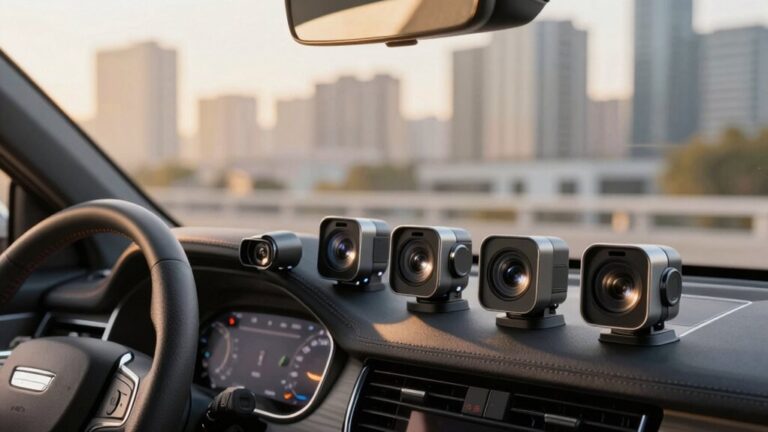

Yes, your dashcam can prove fault in an accident by providing objective, timestamped video evidence that captures critical details like traffic signals, lane positions, and driver behaviors witnesses might miss. Courts and insurance companies regularly accept dashcam footage as credible evidence when it’s authentic, unaltered, and properly preserved. This documentation can speed up your claim resolution by 35-60% and increase favorable outcomes by 40%. Understanding how to maximize your dashcam’s effectiveness guarantees you’ll have the strongest possible evidence when you need it most.
How Dashcam Footage Captures Critical Accident Details
When accidents happen in mere seconds, dashcam footage provides an objective, frame-by-frame account that human memory simply can’t match. Your dashcam records critical driver behavior including lane changes, turn signals, and distracted driving like phone use—details that witnesses often miss or misremember. The footage captures traffic signal compliance, right-of-way violations, and turn indicator usage with precise timing that’s essential for fault determination.
Beyond actions, your dashcam documents environmental factors affecting the crash: weather conditions, visibility limitations, road obstructions, and surface defects. GPS and timestamp metadata verify location and timing. Most importantly, the continuous high-definition recording preserves the entire accident sequence unaltered, creating legally admissible evidence that insurance adjusters and courts rely on when determining liability. The footage can reveal erratic driving patterns that indicate distracted or impaired driving, providing compelling evidence that strengthens your claim. By reducing reliance on eyewitness testimony, dash cam footage makes claims fairer and often quicker to resolve. This unbiased witness perspective can be particularly valuable when dealing with fraudulent insurance claims where parties may misrepresent what actually occurred. Dashcam recordings are especially effective at exposing crash-for-cash schemes where fraudsters deliberately cause collisions to file false insurance claims. To maximize its value in court, the video must meet legal criteria including relevance, authenticity, and a clear chain of custody. While dashcams are legal in all 50 states, their placement and use must comply with state-specific regulations regarding mounting location and audio recording consent.
Legal Acceptance and Admissibility of Dashcam Evidence
While dashcam footage provides compelling documentation of accident events, its value in legal proceedings depends entirely on meeting specific admissibility standards. You’ll need to authenticate the footage through sworn testimony, verify its integrity via metadata and timestamps, and establish an unbroken chain of custody. Courts require proof that the recording is genuine, unaltered, and clearly depicts the incident.
Evidentiary standards demand your footage be relevant, material, and compliant with privacy laws—particularly regarding audio recordings and consent requirements. Audio recording is especially sensitive and may require consent under state wiretapping laws, particularly in all-party consent jurisdictions. Illegally recorded audio can lead to fines, lawsuits, or render the footage inadmissible in court or insurance claims. Jurisdictional variations greatly influence admissibility; some courts impose stricter requirements than others. You must verify the footage was legally obtained, notify opposing parties, and demonstrate it meets your locale’s specific procedural rules. The footage should clearly show the incident to provide an accurate reflection of events and meet the court’s evidentiary standards. Beyond establishing fault in court, dashcam evidence can help prevent wrongful liability claims and protect you from premium increases that typically follow at-fault accidents. However, such footage can also work against you if it reveals illegal actions like speeding, illegal lane changes, or aggressive driving behavior. While there is generally no legal requirement to proactively inform your insurer about having a dash cam, you may need to provide the footage once an accident occurs and a claim is filed. Consulting legal counsel guarantees proper introduction of your dashcam evidence.
The Role of Dashcams in Insurance Claim Processing
As insurance companies process millions of collision claims annually, dashcam footage has emerged as a transformative tool that fundamentally alters how insurers evaluate liability and expedite settlements. You’ll experience 35-60% faster claim resolution when you provide video evidence, reducing processing time from months to weeks. The dashcam benefits extend beyond speed—you’re 40% more likely to receive favorable outcomes compared to drivers without footage. Insurers rely on this objective evidence to combat fraud, verify traffic conditions, and eliminate conflicting witness accounts. High-quality cameras with GPS tracking strengthen your claim through documented speed and location data. Premium models featuring Sony Starvis sensors deliver superior video quality in low-light conditions, ensuring critical details remain visible during nighttime incidents. By streamlining insurance processing and reducing administrative costs, dashcams improve both insurer efficiency and your overall claims experience while protecting against wrongful liability assignments. In the UK, all 29 major insurers surveyed confirmed they would consider dash cam evidence during the claims process. Advanced dash cams with parking mode can even capture incidents while your vehicle is unattended, providing crucial evidence for hit-and-run cases or vandalism claims. Models equipped with motion detection and impact sensors automatically activate when suspicious activity occurs near your parked vehicle, ensuring comprehensive protection around the clock. For drivers in hot climates like Florida, Arizona, and Texas, selecting a dash cam with supercapacitor technology ensures reliable operation even when cabin temperatures exceed 170°F. Dashcam footage also serves as a deterrent against reckless driving and helps prevent fraudulent claims from manipulating the claims process.
Potential Drawbacks and Limitations of Dashcam Recordings
Despite the significant advantages dashcams offer in insurance claims, these recording devices carry inherent limitations that can undermine their effectiveness as definitive proof of fault. Poor video quality from low-grade cameras produces grainy footage that fails to capture critical details like license plates or traffic signals. Most dashcams have fixed, narrow fields of view, missing side impacts or pedestrian movements outside the lens angle. The two-dimensional nature distorts depth perception, making distance assessment difficult during lane changes or following incidents. Dashcam limitations extend to legal admissibility—courts may reject improperly authenticated footage or recordings that violate privacy laws. Additionally, video evidence often lacks context explaining driver behavior, such as sudden braking caused by unseen hazards. Dash cams typically record only the front and rear views, missing side details that could be crucial to determining how an accident occurred. Inadequate memory storage can result in crucial footage being overwritten before it can be preserved as evidence. Even cameras without Wide Dynamic Range technology may produce washed-out or overly dark footage in high-contrast lighting situations, obscuring critical evidence during transitions between bright and dark environments. Improperly configured G-sensor sensitivity may fail to lock critical footage during an impact, allowing important crash recordings to be deleted during normal loop recording cycles. Some dash cams lack built-in microphones or proper noise reduction capabilities, preventing the capture of important audio cues such as honking, screeching tires, or verbal exchanges that could provide crucial context during accident investigations. Dashcam footage must meet proper preservation requirements to maintain its authenticity and ensure it remains admissible in legal proceedings. These constraints frequently necessitate complementary evidence and expert analysis.
Real-World Cases Where Dashcams Determined Fault
When you’re involved in a collision, dashcam footage often transforms contested liability disputes into clear-cut determinations of fault. Courts across Florida and Washington have relied on dashcam reliability to assign liability percentages under comparative negligence laws. In multi-vehicle accident scenarios, video evidence has proven decisive when witness accounts conflict or physical evidence remains ambiguous. Legal teams successfully counter unfair partial fault assignments from insurance adjusters by presenting timestamped footage showing traffic violations—red light runners, illegal lane changes, and failure to yield. Judges admit these digital recordings as credible evidence when authenticity standards are met. Insurance fraud cases particularly benefit from dashcam documentation, exposing staged collisions and false injury claims that would otherwise succeed. These compact recording devices mounted on dashboards provide the unbiased visual documentation necessary to cut through conflicting testimonies that often arise after accidents. For the footage to hold up in court, it must be relevant, authentic, unaltered, and properly authenticated to meet evidentiary requirements. The real-time footage captured by dash cams serves as crucial evidence in exonerating innocent drivers and reducing disputes that might otherwise escalate into prolonged legal battles. Advanced systems with 3-channel recording simultaneously capture front, rear, and 360-degree views, eliminating blind spots that could leave critical moments undocumented. Many dash cams also feature parking mode recording that continues capturing footage even when the vehicle is parked, providing additional evidence of incidents that occur while the car is unattended. Your dashcam footage provides the objective proof necessary to protect your legal rights and financial interests. Maintaining your dashcam’s rechargeable lithium polymer battery ensures continuous operation and reliable evidence capture when you need it most.