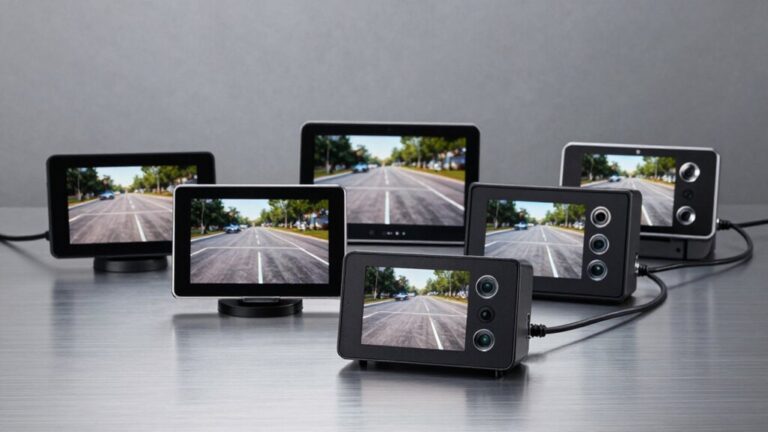

A dual channel dash cam features two synchronized cameras that simultaneously record both the front and rear of your vehicle, typically capturing footage at 1080p-4K resolution in front and 720p-1080p in the rear. You’ll benefit from extensive incident documentation with 140°-170° front coverage and 100°-150° rear coverage, while built-in G-sensors automatically preserve critical footage during impacts. This dual-camera setup provides complete situational awareness that strengthens insurance claims and protects against rear-end collisions—capabilities that extend far beyond these fundamental features.
Understanding Dual Channel Dash Cam Technology
In modern vehicle safety systems, dual channel dash cams utilize two synchronized cameras to record simultaneous footage from your vehicle’s front and rear perspectives. These systems integrate two distinct camera units with strategic camera placement—one mounted near your rearview mirror capturing forward traffic, and another positioned to monitor the rear window. The front camera typically delivers superior recording quality at 1080p resolution with a 170-degree field of view, while the rear camera operates at 720p with 100-120-degree coverage. This dual-sensor configuration guarantees thorough documentation of road incidents without coverage gaps. Loop recording automatically overwrites older footage when storage reaches capacity, while the built-in G-sensor detects sudden impacts, immediately protecting critical video files in designated folders for evidence preservation. Many advanced models feature GPS tracking capabilities that record your vehicle’s location and speed data alongside video footage. Premium dual dash cams now offer 4K video resolution for enhanced clarity and detail in capturing critical road events. High-end models incorporate Sony STARVIS 2 sensors that provide exceptional low-light performance for superior nighttime recording quality. Some systems also include advanced parking modes that enable continuous surveillance and protection even when your vehicle is unattended. Modern dual channel systems increasingly offer Bluetooth-enabled connectivity for wireless control and easier file transfers directly to your smartphone. Advanced systems utilize super-capacitor technology for enhanced durability and reliable operation in extreme temperature conditions where traditional battery-powered cameras may fail.
Key Features and Technical Specifications
Modern dual channel dash cams incorporate advanced technical specifications that directly impact recording performance and reliability. You’ll find front cameras delivering 4K UHD resolution while rear cameras typically offer 1080p Full HD, both operating at video frame rates around 30fps for smooth capture. High-performance models employ Sony STARVIS or OmniVision sensors with HDR technology for superior low-light imaging. Storage capacity ranges from 128GB to 512GB via microSD cards, with premium units featuring up to 256GB internal eMMC storage. Loop recording automatically overwrites oldest footage, while G-sensors lock critical files. Connectivity features include dual-band Wi-Fi, GPS modules, and touchscreen LCDs up to 3.0 inches. Advanced models now offer LTE connectivity for real-time features like remote streaming and live GPS tracking, enhancing vehicle monitoring capabilities. Hardwiring kits extend approximately 4 meters, enabling parking mode with impact detection to prevent battery drain through ACC detection. The built-in G-sensor automatically saves footage during sudden movements or impacts, ensuring critical incidents are preserved before being overwritten. Some advanced models now include voice control functionality for hands-free operation, allowing drivers to manage recording settings without taking their attention off the road. A wider field of view allows the camera to capture more of the road and surrounding environment, with angles typically ranging from 140 to 170 degrees. Premium dash cams feature night vision capabilities that utilize advanced image processing to ensure clear video capture in low-light and nighttime driving conditions. Top-performing models like the Rove R2-4K Dual provide excellent front and rear video quality with wide-angle coverage at an accessible price point for most drivers.
Front and Rear Camera Coverage Explained
Understanding how dual channel dash cams distribute recording responsibilities between front and rear cameras reveals why they’ve become essential for thorough vehicle protection. Your front camera typically captures footage at 1080p to 4K resolution with a 140°-170° field of view, maximizing road coverage and detail. Front camera advantages include superior image quality and wider angles that reduce blind spots, essential for documenting forward incidents clearly.
Your rear camera records at 720p-1080p with a narrower 100°-150° FOV, optimized for direct rear coverage. Rear camera limitations include lower resolution and reduced FOV compared to front units, though this balances detail preservation with adequate rearward visibility. Both cameras operate simultaneously, providing continuous split-screen or toggle-view monitoring. Advanced models like the Vantrue N4 Pro incorporate voice control for hands-free operation alongside their dual-camera recording capabilities. Strategic positioning—front behind the rearview mirror, rear on the windshield or exterior—ensures complete protection. Motorcycle riders benefit from dual-channel systems like the INNOVV K6, which features 2K front and 1080p rear cameras with waterproof construction and flexible mounting options. To handle the constant overwrites from continuous dual-camera recording, using high endurance SD cards specifically engineered for write-intensive dash cam environments is critical for reliability. Many dual-channel models support parking mode to monitor your vehicle for vandalism, hit-and-runs, or theft while parked using motion detection and impact sensors. High-resolution dual-channel systems excel at license plate capture, a crucial feature for documenting incidents and supporting insurance claims with clear evidence. This dual-camera setup provides comprehensive coverage of vehicle surroundings that a single-channel dash cam cannot achieve.
Advantages Over Single Channel Systems
While single-channel dash cams offer basic front-facing protection, dual-channel systems deliver thorough incident documentation that captures your vehicle’s complete operational environment. You’ll record rear-end collisions, hit-and-runs, and parking lot incidents from multiple angles, strengthening your position in insurance claims and legal disputes.
The safety benefits extend beyond accident documentation. Dual-channel footage deters insurance fraud by providing objective evidence that refutes false claims and exaggerated damage reports. You’ll protect yourself against wrongful blame in rear-end collisions and passenger disputes in rideshare scenarios. Some dual-channel systems include a split-screen display that allows simultaneous viewing of both camera feeds for easier incident review. The clear video evidence reduces reliance on eyewitness testimony, making claims fairer and often quicker to resolve. Top models like the Viofo A329 deliver excellent 4K front and 2K rear video quality with strong low-light performance for reliable license plate capture. Advanced features like automatic clip locking preserve critical footage when incidents are detected, ensuring important evidence isn’t overwritten during loop recording. Modern dual-channel systems with Sony STARVIS 2 sensors and HDR capability further improve night recording performance by reducing noise and motion blur in challenging lighting conditions. Premium dash cams with Wi-Fi 6 connectivity enable exceptionally fast video downloads of up to 30 MB/s, allowing you to quickly transfer evidence to your phone or computer for review and sharing.
From a cost perspective, you’ll spend less than purchasing two separate single-channel systems while managing only one memory card, power source, and app interface. The insurance implications favor dual-channel adoption—comprehensive multi-angle evidence improves claim credibility and increases favorable dispute outcomes.
Installation Process and Requirements
Proper installation of your dual-channel dash cam requires strategic planning before you mount any hardware. You’ll need installation tools like plastic trim removers to prevent damage during cable routing through your vehicle’s interior. Mount the front camera behind your rearview mirror after cleaning the windshield with isopropyl alcohol, then position the rear camera inside your rear windshield or near the license plate.
Cable routing demands careful attention—tuck wires within headliners, A-pillars, and door trims to maintain a factory-clean appearance. For power, you can use the cigarette lighter socket or hardwire directly to your fuse box using ACC, constant power, and ground connections. Hardwiring enables parking mode features and eliminates dangling cables, though it requires fuse taps and proper ground point identification for reliable operation. When using a fuse tap, ensure you select one that matches your vehicle’s fuse type such as mini, micro2, or low-profile for proper fit and electrical safety. Alternatively, smart power adapters like the Dongar Pro offer plug-and-play installation by tapping into your rearview mirror’s power source without permanent modifications. Many hardwire kits include a voltage cut-off feature that protects your car battery from draining when the dash cam operates during extended parking periods. Before completing your installation, insert a microSD card to ensure your dual-channel system can begin recording footage immediately. To achieve optimal compatibility and performance, match your hardwire kit to your specific dash cam brand when choosing a permanent power solution. After mounting and connecting all cables, test the device by starting the car and adjusting the camera angle for optimal road coverage.
Advanced Functions: GPS, Night Vision, and Parking Mode
Modern dual-channel dash cams integrate three critical advanced functions that transform basic recording devices into all-encompassing vehicle security systems: GPS tracking, night vision technology, and parking mode surveillance.
GPS logging captures precise location coordinates, speed data, and route information synchronized with your footage. You’ll access mapped playback and geofencing alerts while maintaining timestamp accuracy across time zones.
Night vision employs low-light sensors with wide apertures (F1.8) and HDR processing to capture license plates and road signs in darkness. Advanced CMOS sensors guarantee continuous recording quality regardless of lighting conditions. High-performance models utilize Sony STARVIS CMOS sensors to deliver exceptional image clarity in low-light environments. Front cameras with F1.5 aperture lenses provide enhanced light capture capabilities, optimizing license plate recognition even in challenging visibility conditions.
Parking mode activates motion-triggered or time-lapse recording when your engine’s off. G-sensors detect impacts, automatically saving critical footage while voltage monitoring prevents battery drain. You’ll receive incident notifications for events occurring during vehicle absence. This feature provides protection against fraudulent claims by documenting events that occur while your vehicle is unattended. Super capacitors provide superior reliability compared to traditional batteries, especially when operating in extreme temperature conditions. Look for systems with glare reduction technology to ensure clear footage even when parked in bright sunlight or near reflective surfaces.
Cost Considerations and Value Assessment
Understanding these advanced capabilities prepares you to evaluate whether their implementation justifies the investment required. Dual-channel dash cams typically start around $130-$160 for entry-level models, while premium 4K systems reach $300-$500+. The cost implications extend beyond initial purchase—subscription fees for cloud connectivity and hardwiring installations add operational expenses.
For value analysis, prioritize models with Sony STARVIS 2 sensors above $120, as superior night vision and image clarity directly impact footage usability. Budget options compromise sensor quality, while premium units deliver 4K+4K resolution with HDR technology for enhanced license plate readability.
Consider long-term factors: firmware update availability, warranty coverage, and expandable storage capacity (128GB-256GB eMMC). The rear camera connects to the front camera unit, eliminating the need for separate memory cards and simplifying your storage management. Higher upfront costs often correlate with reliable evidentiary footage across lighting conditions, maximizing your investment’s protective value. Top-tier models like the Viofo A329S utilize the Sony IMX678 sensor to deliver exceptional 4K front recording quality with flexible one to three channel configurations.
Practical Applications and Use Cases
Beyond mere video recording, dual channel dash cams serve distinct operational roles that address specific vulnerabilities in modern driving scenarios. You’ll find usage scenarios spanning insurance fraud prevention, where simultaneous front-rear documentation expedites claims processing and reduces liability disputes. Commercial fleets deploy these systems for driver accountability and regulatory compliance, while real-time alerts improve operational efficiency. For parking security, motion-activated recording captures hit-and-run incidents when you’re absent. Family safety enhancements include monitoring teenage drivers and protecting vulnerable passengers. Ride-share operators utilize cabin cameras to mitigate false claims. Law enforcement applications leverage timestamped, multi-angle footage as court-admissible evidence. GPS integration provides speed and location data, while HDR and night vision guarantee documentation reliability across lighting conditions, delivering thorough protection beyond standard recording capabilities. Daily commuters frequently in heavy traffic benefit from comprehensive rear coverage that protects against rear-end collisions and potential insurance fraud.