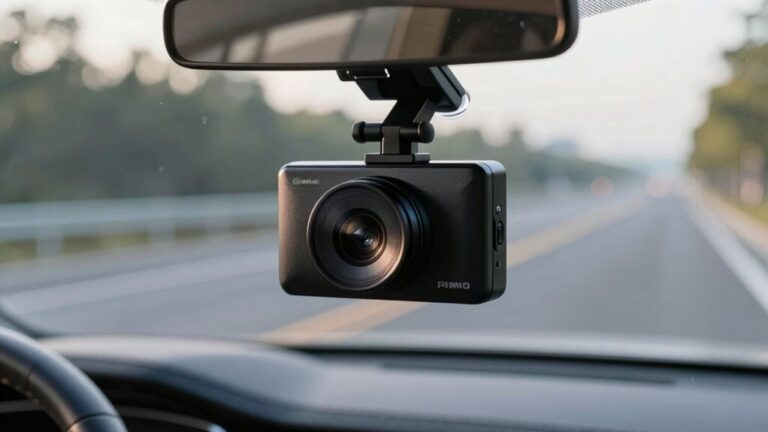

Dash cams are legal in all 50 U.S. states, but you’ll need to comply with varying state-specific regulations on mounting locations and audio recording consent. While dashboard mounting is universally permissible, ten states prohibit windshield mounting entirely, and others restrict placement to designated zones of 5–7 square inches. Additionally, 11 states require all-party consent for audio recording, while 38 states plus D.C. only require one-party consent. Understanding your jurisdiction’s particular requirements will help you avoid penalties and maximize your footage’s evidentiary value in potential legal proceedings.
General Legal Status of Dash Cams Across the United States
Dash cams are legal in all 50 states across the United States, though you’ll find that state laws impose varying restrictions on their placement and use. These regulations primarily address mounting locations to prevent driver view obstruction and recording practices to guarantee privacy compliance. Despite dash cam history showing their evolution from basic recording devices to sophisticated surveillance tools through technological advancements, their classification varies by jurisdiction. Some states categorize them as surveillance devices, triggering additional regulatory requirements. You must make sure your dash cam doesn’t obstruct visibility and complies with audio recording consent laws, which differ greatly between one-party and all-party consent states. When mounting on the windshield, devices should be between 5 and 7 square inches to meet legal size requirements in most jurisdictions. Legally obtained, unaltered footage generally remains admissible in court proceedings across jurisdictions. While there’s no legal requirement to proactively inform your insurer about your dash cam, you may need to provide the footage once an accident occurs and a claim is filed. While most insurers don’t offer direct discounts for dash cams, the footage can help prevent wrongful liability claims and avoid premium increases. Fleet and commercial vehicle dash cams are also legal when drivers are properly informed and privacy rules are followed. These devices serve as an unbiased witness by recording real-time footage that can be crucial in providing evidence during accidents or disputes. To ensure your dash cam footage is admissible in court, you should maintain a clear chain of custody and be prepared to verify that the recording has not been tampered with.
Windshield and Dashboard Mounting Requirements by State
While dash cams enjoy legal status nationwide, you’ll find that mounting location requirements vary considerably across jurisdictions, with violations potentially resulting in citations for obstructed view or equipment infractions. Ten states—including Virginia, Pennsylvania, and Montana—prohibit windshield mounting entirely under windshield laws, mandating dashboard placement exclusively. California permits windshield mounting within a 5-inch square upper center or 7-inch square lower corners. Nevada restricts devices to 6-inch squares in the lower passenger corner. Vermont’s dashboard regulations specify detailed dimensions: 4 inches tall by 12 inches wide lower right, or 2 inches by 2.5 inches upper left. Wisconsin allows mounting only behind the rearview mirror, outside wiper sweep zones. Dashboard mounting remains universally permissible and recommended for compliance, though placement mustn’t obstruct airbags or driver vision per local safety standards. Modern dash cams with ADAS features integrate front, rear, and side cameras to continuously monitor the driving environment and provide real-time safety alerts. Premium models like the Vantrue Nexus series offer multi-angle coverage with quadruple camera setups that provide comprehensive video documentation while meeting legal mounting requirements. Dash cams typically connect to the car’s electrical system through the cigarette lighter or require a hardwired connection for continuous power and automatic operation. Proper installation must ensure that dash cams cannot interfere with airbag deployments or compromise critical safety systems. Many dash cams now offer Wi-Fi connectivity to allow users to view, download, and share footage directly through a smartphone app. Because dash cam footage can impact both liability and insurance claims, it is advisable to consult a lawyer before submitting such videos as evidence in court or sharing them with insurers.
Understanding Audio Recording Consent Laws
Beyond mounting regulations, you must navigate consent laws governing audio recording capabilities before activating your dash cam’s microphone. Audio recording laws vary greatly across jurisdictions, with 38 states plus Washington D.C. requiring only one-party consent, while 11 states—California, Delaware, Florida, Illinois, Maryland, Massachusetts, Montana, Nevada, New Hampshire, Pennsylvania, and Washington—mandate all-party consent. Federal law aligns with one-party consent requirements for participants in communications. The distinction between private and public conversations affects legal scope, with courts interpreting consent requirements differently based on recording context. Some states maintain ambiguous or mixed rules, such as Oregon’s differing standards for electronic versus in-person recordings. You should provide visible notification or explicit verbal announcement when recording to minimize legal risks, particularly in all-party consent states where violations may result in criminal charges and civil liabilities. Understanding these consent requirements is crucial for legal compliance when operating dash cam recording features. While navigating these legal requirements, many drivers find that dash cams with parking mode surveillance capabilities provide enhanced security benefits that justify careful attention to consent law compliance. When properly configured within legal boundaries, dash cam footage reduces reliance on eyewitness testimony by providing objective documentation that makes insurance claims fairer and quicker to resolve. Additionally, dash cams that record video without audio can still serve as an impartial eyewitness to refute staged accidents and protect you from fraudulent insurance claims. The footage can also demonstrate traffic violations such as running red lights or illegal turns when determining fault in insurance claims and court proceedings. Many modern dash cams include Wi-Fi connectivity that allows you to easily access recorded footage on your smartphone for immediate review and evidence sharing.
Key State-by-State Differences and Regulations
Audio recording consent requirements form only part of the regulatory framework governing dash cam use, as mounting restrictions and placement rules vary markedly across jurisdictions. State regulations differ considerably on windshield placement: California permits mounting only in limited zones behind the rearview mirror, while Alabama prohibits windshield mounting entirely. Minnesota restricts devices to specific areas near mirrors, and Alaska enforces size limits under five square inches. Dashboard mounting remains widely acceptable across most states, avoiding obstruction violations. Consent laws intersect with placement rules to create jurisdiction-specific compliance frameworks. You must verify both audio recording statutes and physical mounting restrictions in your state. Courts generally accept lawfully recorded footage, but violations of either placement requirements or Consent laws may compromise admissibility and result in citations. Indiana requires installation in the bottom corner of the passenger side with a maximum size of 4 square inches. Proper installation also requires attention to camera angle, with experts recommending a 60% road and 40% sky ratio for balanced exposure and optimal footage quality. To prevent battery issues, consider connecting your dash cam to a power source that switches off with the ignition rather than hardwiring directly to the battery with continuous parking mode enabled. Recording video on public roads is generally permissible since there is little expectation of privacy in public spaces. Modern dual-channel systems record simultaneously from front and rear perspectives, ensuring maximum coverage and evidence capture on the road. High-end models now offer 4K resolution for superior image clarity, making license plates and road details easier to identify in recorded footage.
Privacy Rights and Surveillance Restrictions
Recording public roads is generally permissible, yet capturing private property or vehicle interiors raises significant privacy implications. Cabin-facing cameras monitoring driver behavior demand heightened attention to surveillance ethics, particularly in employment contexts balancing oversight against employee privacy rights.
You must implement secure data handling protocols: encryption, password protection, and documented chain of custody maintain evidence integrity. Employers should provide transparent disclosure about recording scope and timing. AI-enabled behavioral tracking (distraction, drowsiness detection) intensifies privacy risks, requiring explicit policies and employee consent where mandated by state law. Dash cams capturing crucial footage serve as vital evidence for insurance claims and legal matters when privacy regulations are properly followed. The presence of dash cams increases driver accountability by encouraging more responsible behavior, as individuals tend to curb reckless and aggressive actions when aware they are being recorded. Many modern dash cams use supercapacitors instead of batteries, which continue recording briefly after power loss to capture complete incident footage while offering superior heat resistance and reliability in extreme vehicle temperatures. Advanced models now feature real-time app sharing capabilities that enable immediate video transfer to smartphones for quick incident documentation and evidence preservation. Dash cams with parking mode features automatically activate upon detecting motion or impacts, recording vandalism and hit-and-run incidents while your vehicle is unattended. To preserve critical footage, most dash cams allow users to lock or protect specific clips, preventing automatic deletion when loop recording overwrites older files.
Federal Safety Standards for Dash Cam Installation
While privacy concerns shape how you record, physical installation requirements determine where you can legally mount your dash cam. Under FMCSA 49 CFR § 393.60(e), effective May 6, 2022, you must follow strict installation guidelines limiting windshield mounting to a 7-inch square on the passenger side or 5-inch square on the driver side. You can’t mount cameras more than 8.5 inches below the upper windshield edge within the wiper sweep area. Your device mustn’t obstruct your view of road signs, signals, or interfere with airbag deployment. Dashboard or rearview mirror mounting provides alternative safety compliance when windshield zones aren’t feasible. Modern dash cams feature loop recording that automatically overwrites the oldest footage once your memory card fills up, ensuring continuous recording without manual file management. Strategic placement behind the rearview mirror not only helps maintain compliance but also reduces exposure to direct sunlight, minimizing overheating risks that can shorten your device’s lifespan. Manufacturers and fleet operators must verify installations meet both federal FMCSA standards and applicable state regulations to avoid inspection failures and fines. Professional installation services can ensure your dash cam meets all federal mounting requirements while maintaining optimal viewing angles and secure wiring. Understanding whether you need a single-channel dash cam or a more comprehensive dual-channel or three-channel system will help you determine the best compliant mounting configuration for your specific recording needs. Regular collaboration with compliance consultants ensures your installation practices align with evolving regulatory requirements.
Using Dash Cam Footage as Evidence in Legal Proceedings
When submitting dash cam footage in court, you must satisfy several evidentiary requirements before judges will admit your recording. Admissibility criteria include demonstrating the footage’s relevance to disputed facts and establishing proper chain of custody documentation. Footage authentication requires witness testimony confirming the camera’s setup, date/time stamps, GPS data, and device specifications. Courts analyze whether probative value outweighs potential prejudice or confusion.
You’ll need to preserve metadata embedded in video files and provide affidavits substantiating the recording’s reliability. The “silent witness” theory permits video evidence without eyewitness testimony if you prove the system’s dependability. However, edited or manipulated footage faces exclusion due to authenticity concerns. Audio recordings may require compliance with state consent laws. Your footage should provide a real-time account of incidents to effectively support your case and clarify disputed facts. Dash cam footage can capture objective, time-stamped documentation of critical details like license plates, vehicle descriptions, and driver behavior that help establish fault in accidents. Before sharing footage with insurers or opposing parties, consult legal counsel to assess evidentiary impact.
Best Practices for Lawful Dash Cam Use
To guarantee your dash cam operates within legal boundaries, you must follow jurisdiction-specific mounting regulations that prioritize driver visibility and roadway safety. Best installation practices include positioning devices behind the rearview mirror or within designated windshield zones (typically 5–7 square inches), assuring compliance with federal FMCSA 49 CFR § 393.60(e) for commercial vehicles. You’ll need to obtain proper consent before activating audio recording—one-party consent in some states, all-party in jurisdictions like California, Illinois, and Pennsylvania. Implement responsible footage management by maintaining secure storage with timestamps, establishing access controls, and protecting recorded individuals’ privacy rights. You should provide clear passenger notification through visible signage and confirm your mounting setup doesn’t interfere with airbags or controls, minimizing driver distraction while maximizing evidentiary value. Courts typically accept dash cam footage as evidence when it remains relevant and unaltered, emphasizing the importance of maintaining original files without editing or modification.