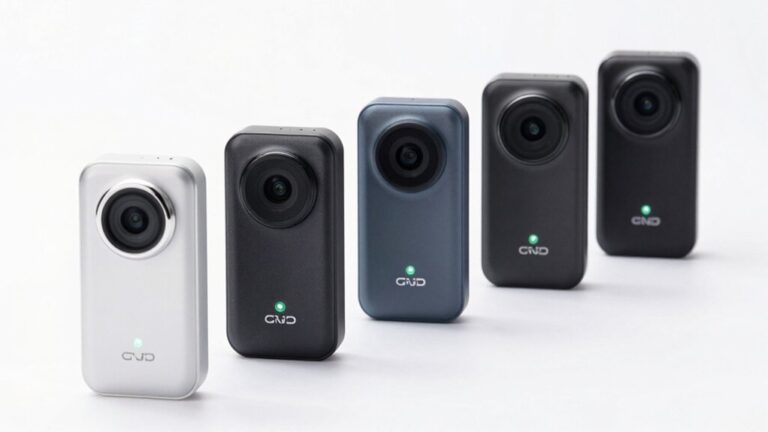

Your dash cam captures video in segmented clips and transmits them to remote servers via cellular (4G LTE) or Wi-Fi connectivity. The system uses AES-256 encryption to protect your footage during transfer and storage. G-sensors automatically trigger uploads during collisions or significant impacts, while motion detection activates recording in parking mode. You’ll receive real-time notifications and can access your footage from any internet-connected device. The technology integrates GPS tracking and AI-powered monitoring to provide thorough vehicle surveillance, and exploring these advanced features reveals how cloud storage transforms traditional dash cam capabilities.
What Is Dash Cam Cloud Storage Technology?
Dash cam cloud storage technology fundamentally transforms how drivers preserve and access their recorded footage by transmitting video data from the vehicle-mounted camera to remote servers via internet connectivity. Unlike traditional SD card-based systems, cloud storage provides unlimited capacity and protects your footage from device theft, physical damage, or tampering. Your dash cam connects through cellular networks (4G LTE) or Wi-Fi, enabling automatic uploads triggered by G-sensor impacts or motion detection. You’ll receive real-time notifications and can remotely access videos from smartphones or computers anywhere. This technology integrates GPS tracking, live streaming capabilities, and AI-powered driver monitoring while maintaining security through encryption protocols and authenticated access controls. Modern systems offer multi-channel setups that can include additional cameras for interior monitoring or blind spot coverage beyond standard front and rear views. Advanced models feature 4K UHD resolution paired with Sony sensors to capture crystal-clear footage both day and night, ensuring critical details are preserved in cloud storage. When choosing resolution, 2.5K cameras provide a balanced approach between image clarity and storage efficiency, delivering better detail than 1080p while requiring less cloud storage space than 4K models. Cloud-enabled dash cams also provide real-time driver alerts with visual and audio in-cab notifications to promote safer driving habits and reduce collisions. Cloud storage eliminates the risk of losing critical evidence, supporting insurance claims and legal documentation without requiring physical retrieval. Some models offer secure cloud storage without extra subscription fees, making premium features accessible for everyday drivers and fleet operators. The continuous monitoring capability serves as an unbiased witness that can provide crucial evidence in cases of vandalism, hit-and-run incidents, or fraudulent insurance claims.
How Video Capture and Upload Process Works
When your dash cam initiates recording, it captures video in segmented clips—typically three-minute intervals—that are saved sequentially to the micro-SD card rather than as one continuous file. This segmentation guarantees manageable file sizes and facilitates efficient retrieval. Video compression techniques optimize storage capacity, though higher resolutions consume more space and reduce total recording duration.
Cloud uploads utilize event triggered recording, activating when sensors detect impacts or sudden braking. This prioritizes critical incidents over continuous footage, optimizing bandwidth and cloud storage allocation. Upon detection, your dash cam automatically uploads event files when connected via Wi-Fi or LTE. Some models upload full resolution, while others transmit downgraded versions to expedite transfer. Upload speed correlates directly with connection quality and file size, requiring active connectivity at the event moment for successful cloud backup. Many phone-compatible dash cams enable live streaming of footage directly to your smartphone for real-time monitoring. Cloud backups allow access from any device with internet connection, providing flexible retrieval options regardless of your physical location. This footage can serve as valuable evidence in accidents, helping to prove fault and protect against wrongful liability claims. Users can also download clips directly to their phone for easy viewing or sharing with insurance companies or law enforcement. Advanced models may also feature radar-based parking detection that triggers uploads when motion is detected around your parked vehicle. Similar to backup cameras, ensuring your wiring connections are properly secured is critical for maintaining reliable power supply and consistent cloud upload functionality.
Connectivity Options for Cloud-Enabled Dash Cams
Cloud-enabled dash cams employ multiple connectivity technologies to establish reliable pathways between your vehicle and remote servers. Cellular connectivity via 4G LTE networks enables immediate, automatic upload of event-triggered footage detected by G-sensors, while supporting real-time GPS tracking, live streaming, and push notifications. You’ll need to activate SIM profiles and data plans for continuous cloud service functionality. Wi-Fi integration serves as a complementary option, facilitating large data transfers, firmware updates, and app-based device management when near trusted hotspots. Bluetooth connectivity ensures stable smartphone pairing for app control and collision alerts. Even if the dash cam is damaged or stolen during an incident, securely uploaded footage remains accessible from your cloud account. Advanced hybrid systems combine LTE, Wi-Fi, and Bluetooth to optimize upload reliability and minimize cellular data costs while maintaining seamless remote access—particularly beneficial for fleet management applications requiring uninterrupted video monitoring. Models like the Blackvue DR970X-2CH LTE Plus integrate both LTE and cloud features to provide comprehensive wireless connectivity and automated cloud backup capabilities. Since dash cams are legal in all 50 states and their footage is widely accepted in insurance claims and accident investigations, cloud storage ensures your evidence is preserved and readily available when needed. Modern dash cams with built-in WiFi allow you to download videos directly to your smartphone through dedicated apps without consuming mobile data, making it convenient to review and share footage immediately after an incident. Budget-friendly options like the Redtiger F7N offer app connectivity for convenient footage downloads, combining cloud-compatible features with affordable pricing for users seeking reliable video access without premium costs.
Real-Time Monitoring and Alert Features
Beyond establishing robust data pathways, modern dash cams leverage these connectivity systems to deliver sophisticated real-time monitoring capabilities that transform passive recording into active vehicle intelligence. G-sensor technology detects collisions, sudden impacts, and abrupt movements instantly, triggering automatic video clip capture and immediate cloud upload to preserve critical evidence even if the device sustains physical damage. Companion apps deliver real-time alerts through push notifications, enabling immediate emergency response or remote assistance coordination. Live monitoring functionality streams video feeds to mobile devices in under four seconds on superior networks, allowing you to surveil vehicle surroundings during parking or transit. AI-powered detection algorithms differentiate genuine security threats from background noise, filtering false alerts while automatically tagging events like distraction, fatigue, or aggressive driving maneuvers for streamlined review and fleet management compliance. These systems can reward fleet drivers with good driving behavior through objective performance data and coaching opportunities. Research demonstrates that targeted behavioral coaching using dash cam footage can reduce fatal crashes by up to 20% and injury crashes by 35% through correction of unsafe driving patterns. Advanced Driver Assistance Systems enhance safety through lane departure warnings and collision alerts that activate based on real-time road conditions. The Lane Departure Warning feature uses the forward-facing camera to monitor lane positioning and issues visual, audible, or vibration alerts when unintentional drifting occurs without turn signal activation. Some systems incorporate Forward Collision Warnings that analyze the distance and closing speed between your vehicle and others ahead to issue alerts before potential impacts occur. High-end models feature thermal sensors and automatic shutdown capabilities to prevent device damage during extreme temperature conditions.
Key Advantages Over Traditional SD Card Storage
While traditional SD card storage has served as the foundation for dash cam recording since the technology’s inception, cloud-based architectures deliver transformative advantages that fundamentally reshape data management, security, and accessibility paradigms. Unlimited scalable capacity eliminates the chronic constraint of finite local storage—where 32GB or 64GB cards force continuous loop recording and automatic overwriting—enabling you to preserve weeks or months of footage based on subscription tier without manual intervention or data loss concerns. Enhanced data security protects against physical theft, corruption, and card failure through automatic encrypted uploads and redundant backup protocols. Remote accessibility provides user convenience through instant footage retrieval via mobile applications, eliminating physical card removal for insurance claims or investigations. Automated continuous uploads guarantee real-time backup without user action, while advanced analytics integration enables AI-powered incident detection, fleet management dashboards, and proactive safety coaching—delivering measurable cost benefits through operational efficiency and reduced liability exposure. Cloud-enabled dash cams also facilitate easier insurance claims through verified footage that accelerates the entire claims processing workflow, reducing resolution time and administrative burden for policyholders. Many cloud-connected dash cams utilize Wi-Fi connectivity to establish a local hotspot network that enables mobile app integration for live viewing, file management, and firmware updates without requiring external internet access. Unlike standard cards that deteriorate rapidly under constant recording demands, high endurance SD cards are specifically engineered to handle the intensive read/write cycles and extreme environmental conditions inherent in dash cam applications, offering enhanced durability and longevity. Modern wireless dash cams with cloud capabilities often include parking mode monitoring that captures events even when the vehicle is unattended, providing comprehensive security coverage. Advanced models now offer 4G live viewing options that enable real-time monitoring and instant notifications directly to your smartphone, ensuring you stay connected to your vehicle regardless of distance. Premium systems integrate radar parking mode technology that intelligently detects impacts and nearby motion while minimizing power consumption, allowing extended surveillance periods that can reach up to 40 days without depleting the vehicle battery.
Security Measures and Data Protection
These operational and accessibility advantages depend entirely on robust security architectures that protect your dash cam footage from unauthorized access, interception, and loss. Cloud providers implement advanced encryption methods, applying AES-256 algorithms during transmission and at rest across geographically dispersed data centers. HTTPS protocols guarantee data integrity during uploads, preventing tampering or interception. Multi-factor authentication and role-based access controls restrict viewing permissions to authorized users only, while audit logs track all system interactions for accountability. Data redundancy safeguards against hardware failures by replicating footage across multiple secure locations. Physical data center protections—including controlled access, fire suppression, and power backups—complement digital security layers. Regular encryption software updates address emerging vulnerabilities, maintaining protection against evolving cyber threats targeting sensitive video, GPS coordinates, and driver information. Multiple copies of data stored in various geographic regions provide additional protection against regional disasters or localized system failures. Advanced fleet systems can retain cloud-stored footage for extended periods, with some providers offering retention up to 3 months depending on subscription plans and storage allocation. Reputable cloud storage providers also implement strong data management policies that govern how long footage is retained, who can access it, and when recordings are automatically deleted to protect personal information and maintain compliance with privacy regulations. Cloud-connected dash cams with parking mode features can automatically upload captured incidents to secure servers, ensuring vandalism evidence remains accessible even if the camera itself is damaged or stolen. Many cloud-enabled dash cams with GPS receivers also embed location, speed, and route data alongside the video footage, providing critical contextual information for accident verification and insurance claims.
Remote Access and Fleet Management Capabilities
Cloud-connected dash cams transform vehicle monitoring by delivering instant access to live and recorded footage through cellular or Wi-Fi networks, eliminating the need for physical device retrieval. You’ll receive mobile notifications for event-triggered uploads like harsh braking or collisions, enabling immediate incident review through web portals or apps. Remote viewing capabilities extend to both real-time streaming and historical playback of cloud-stored files.
For fleet operations, integrated GPS tracking links video footage to precise locations and routes. You can monitor vehicle positions in real time, configure geofencing alerts for predefined zones, and analyze driver performance through historical route replays. Two-way voice communication supports direct user interaction between managers and drivers. Many cloud-enabled models also feature Intelligent Parking Mode that monitors vehicles during stationary periods and automatically uploads relevant events. Advanced systems may include loop recording functionality that continuously overwrites older footage to maximize storage efficiency. Over-the-air firmware updates maintain device compatibility, while automated video management systems streamline sharing, permissions control, and insurance documentation workflows. Local storage capability ensures no data loss when vehicles operate outside cellular coverage areas.
AI-Powered Features and Driving Analytics
Modern dash cams leverage artificial intelligence to transform raw video into actionable safety intelligence, detecting risky behaviors and generating analytics that reduce accident rates across individual and fleet operations.
AI analytics continuously monitor driver actions, identifying distraction, fatigue, drowsiness, and phone use in real-time. Advanced Driver Monitoring Systems (DMS) trigger in-cab alerts to correct dangerous behaviors immediately, while proactive coaching algorithms reduce false alarms by up to 90%. Machine learning classifies video clips by event severity—harsh braking, collisions, distracted driving—with GPS coordinates and timestamps for efficient incident review.
Driver profiling enables personalized monitoring across multiple fleet operators, generating detailed metrics on acceleration patterns, braking intensity, and turn sharpness. Cloud dashboards aggregate behavior scores and safety trends, facilitating targeted training. These data-driven insights support regulatory compliance and liability reduction through documented driving behavior. The Driver ID feature helps fleet managers track individual driver performance and attribute specific behaviors to the correct operator.
Parking Mode and Emergency Response Integration
Beyond real-time driving analysis, dash cams extend their protective capabilities through parking mode—a feature that transforms your camera into a 24/7 security system when the vehicle engine shuts off. Motion and impact sensors continuously monitor for events like collisions, break-ins, or vandalism, automatically triggering recording sequences when threats occur.
Parking advantages include LTE-enabled cloud uploading that preserves footage even if the device is stolen or damaged. G-sensors detect impacts and instantly upload clips to secure servers, ensuring tamper-proof evidence storage. Hardwiring the dash cam to your vehicle’s fuse box ensures continuous power supply while preventing battery drain, optimizing the parking mode functionality for extended monitoring periods.
Emergency alerts deliver push notifications to your smartphone when unusual activity is detected, providing detailed information about parking lot incidents including GPS coordinates and timestamps. This integration enables immediate response to hit-and-runs, door dings, or unauthorized vehicle movement through geofencing technology, substantially enhancing unattended vehicle protection.