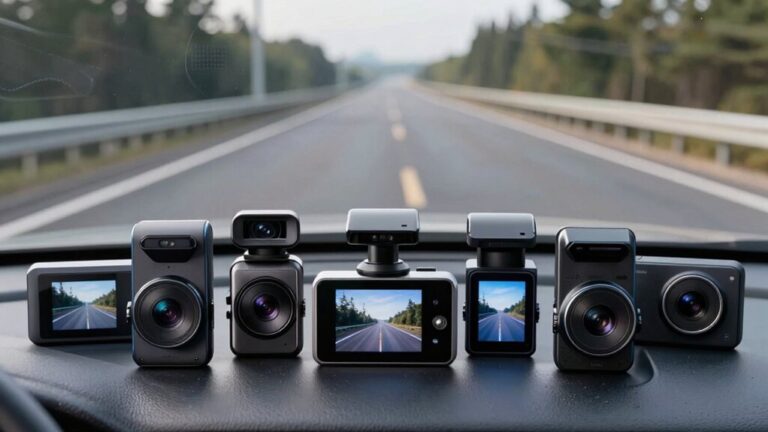

A driver assistance dash cam combines traditional video recording with AI-powered real-time hazard detection to actively monitor road conditions. You’ll receive immediate alerts for forward collisions, lane departures, blind spots, and pedestrian risks—features proven to reduce accidents by up to 29%. These systems utilize advanced processors to analyze over 15 unsafe driving behaviors while capturing 4K video evidence with GPS tracking. Modern models include cloud connectivity for remote monitoring and automated incident documentation that streamlines insurance claims. The sections below explore how these integrated technologies enhance your vehicle’s safety infrastructure.
Understanding Driver Assistance Dash Cams and How They Work
Driver assistance dash cams represent a technological convergence of traditional video recording systems and real-time hazard detection capabilities. You’ll find these devices utilize front-facing cameras paired with AI algorithms to analyze your surroundings continuously. The system processes visual data to identify lane markings, vehicles, pedestrians, and traffic signs, triggering immediate alerts when hazards emerge.
GPS integration enables precise location tracking and speed monitoring, while connectivity features facilitate remote access through mobile applications. The recorded footage serves dual purposes: capturing critical events for accident analysis and monitoring driver behavior patterns. Advanced models incorporate radar sensors to enhance detection accuracy, particularly for forward collision prediction. Like dual camera systems, these devices employ continuous loop recording to manage storage efficiently while preserving critical footage when incidents occur. Modern systems combine machine vision with artificial intelligence to achieve high-accuracy risk detection and provide real-time driver alerts through visual and audio in-cab notifications. Premium models offer high-definition or 4K video recording for clear capture of critical details like license plates and road signage. The integration of sensor fusion technologies combines data from multiple sources to provide comprehensive environmental awareness and more reliable hazard detection. These systems employ Driver Monitoring Systems that use artificial intelligence to detect driver condition and provide audible alerts when signs of fatigue or distraction are identified. Many advanced dash cams now include cloud connectivity to enable real-time monitoring and remote alerts for critical events like impacts or rollovers. This integration transforms your dash cam from a passive recorder into an active safety system that augments situational awareness throughout your journey.
Core ADAS Features That Enhance Road Safety
Modern Advanced Driver Assistance Systems (ADAS) implement specific features designed to address the primary collision scenarios documented in traffic safety research. Forward Collision Warning reduces rear-end crashes by up to 29% through audible, visual, or haptic alerts that prompt immediate braking responses. Lane Departure Warning and Lane Keeping Assistance prevent unintentional drifting, reducing accidents by approximately 19% through camera-based lane marking detection and active steering intervention. Blind Spot Detection continuously monitors adjacent lanes, preventing side-swipe collisions during lane changes with automatic intervention capabilities. Pedestrian Detection systems protect vulnerable road users by automatically applying brakes when collision risks are identified. These core ADAS benefits deliver measurable improvements in road safety by compensating for human reaction limitations and addressing distraction-related incidents through sensor-based monitoring and automated responses. The system minimizes driver reaction delays through automated detection algorithms that identify hazards faster than human perception alone. Top-tier ADAS dash cams combine high-quality video recording with real-time safety alerts to provide both incident evidence and proactive collision prevention for individual drivers and fleet operators. Many modern dash cams with Wi-Fi or cellular connectivity enable live GPS tracking to monitor vehicle location and movement in real-time through smartphone applications. Beyond collision prevention, dash cam footage can protect your driving record by providing evidence that helps prove you were not at fault in accidents, potentially preventing premium increases. The continuous recording capability also serves as protection against fraudulent insurance claims by providing timestamped video evidence that accurately documents the circumstances of any incident. When incidents do occur, dash cam footage can be used in court as evidence in traffic cases and personal injury claims, provided the video meets legal standards for authenticity and reliability.
Advanced Technical Capabilities and Smart Connectivity
Today’s driver assistance dash cams integrate sophisticated AI processors and computer vision systems that enable real-time analysis of complex road environments. AI algorithms process inputs from high-performance sensors to recognize 15+ unsafe driving behaviors, monitor lane positions, and detect pedestrians in blind spots simultaneously across front and rear cameras.
Video quality reaches 4K UHD+ resolution through advanced Omnivision OS04C20 sensors combined with wide dynamic range technology, ensuring crystal-clear footage in varying lighting conditions. Wide-angle lenses spanning 120° to 150° minimize blind spots while dewarping technology reduces edge distortion. Premium models incorporate Sony IMX415 sensors that deliver exceptional image quality even in challenging environments.
Smart connectivity features include built-in Wi-Fi hotspots for smartphone integration, LTE cloud access for fleet monitoring, and GPS geo-tagging. You’ll access live streaming, remote configuration, and firmware updates through compatible mobile apps while storing footage on microSD cards up to 1TB.
Real-World Applications for Personal and Commercial Vehicles
AI-powered dash cams deliver measurable safety improvements across personal and commercial vehicle deployments, with documented collision reduction rates reaching 60% within the first year of implementation. You’ll benefit from driver monitoring systems that analyze facial expressions and eye movement to detect fatigue and distraction, triggering real time alerts before incidents occur. Dual-facing cameras capture both road conditions and in-cab behavior simultaneously, providing thorough documentation for insurance claims and liability disputes. The clear video evidence accelerates the claims process by helping insurers prove fault and protect drivers from fraudulent or false claims. Dashcams function as an impartial eyewitness during incidents, recording objective footage that can conclusively determine fault and expose staged accidents such as crash-for-cash schemes. Fleet operators leverage GPS integration, OBD2 connectivity, and cloud-based analytics to monitor vehicle performance, track route history, and conduct video-based coaching that accelerates safety improvements 60% faster than traditional methods. Emergency SOS features guarantee rapid response during critical situations, while automated event recording streamlines incident investigation and regulatory compliance documentation. Advanced systems incorporate Forward Collision Warning technology that uses object detection to identify potential hazards and alert drivers before impact occurs. Modern dash cams with built-in GPS capabilities enhance incident documentation by providing precise location data and speed information alongside video footage. Professional installation options include hardwire kits that connect directly to the vehicle’s fuse box, enabling parking mode surveillance and battery voltage monitoring to prevent drain during extended recording sessions. Top-tier models feature wide fields of view around 140 degrees to capture multiple lanes of traffic and roadside activity for comprehensive coverage.
The Future of Dash Cam Technology and Safety Integration
As dash cam technology converges with artificial intelligence and vehicle safety systems, you’ll witness transformative capabilities that extend far beyond basic video recording into predictive collision prevention and extensive driver assistance. Multi-camera arrays with up to 11 units deliver 360-degree panoramic coverage, eliminating blind spots through magnetic sensor gimbals that detect real-time threats. Cloud connectivity enables automatic backup, remote access, and instant alert transmission to insurers or authorities. Advanced 4K sensors with AI-enhanced processing capture license plates while implementing privacy-selective blurring. Automated monitoring systems analyze driver behavior continuously, providing in-cab voice feedback on distraction, fatigue, and tailgating. Leading models feature integrated LTE modules that allow direct cloud uploads without requiring smartphone tethering or WiFi connections. These integrated platforms reduce insurance premiums through verified accident prevention data and rapid evidence retrieval, fundamentally transforming vehicle safety infrastructure. Top-rated models with 4K video quality deliver superior image resolution for capturing critical incident details in varying lighting conditions. Professional installers now manage hardwire kit integration with vehicle fuse boxes to enable reliable 24/7 parking surveillance without battery drain concerns.