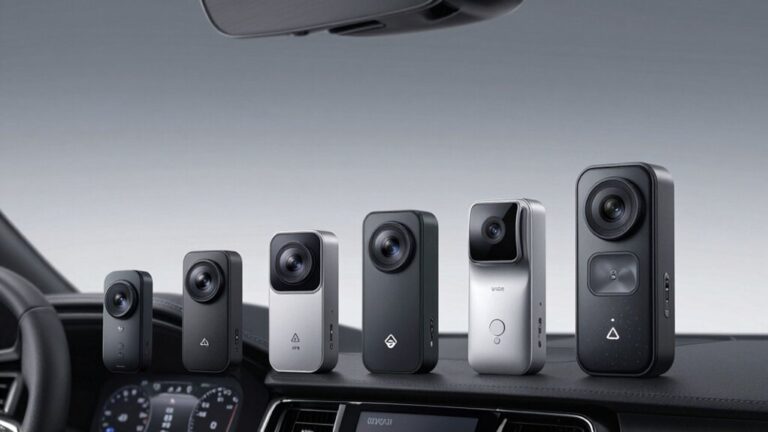

You’ll find that 4K dash cams offer the ideal balance between detail capture and practical functionality, while 5K models are virtually nonexistent in the consumer market. 4K provides 8 million pixels—sufficient for capturing license plates and road signs—whereas 5K’s minimal visual improvement doesn’t justify its 1.5-2x larger file sizes (21-27GB per hour) and considerably higher processing demands. The 4K resolution delivers superior evidence quality without overburdening your storage or vehicle’s electrical system, and understanding the technical factors behind this recommendation will help you make the most informed investment decision.
Understanding Resolution Standards in Dash Cams
Dash cam resolution fundamentally determines how much visual information each video frame captures, with three primary standards dominating today’s market: 1080p (Full HD), 2K (1440p or Quad HD), and 4K (2160p or Ultra HD). Resolution measures pixel count per frame—1080p delivers 1920 × 1080 pixels (2 million total), 2K provides 2560 × 1440 pixels (3.7 million), and 4K outputs 3840 × 2160 pixels (8 million). Higher pixel counts translate directly to superior video clarity, enabling you to identify distant license plates and road signs with greater accuracy. While 1080p remains the most affordable standard, 2K offers 1.8× more detail without excessive file sizes. Among essential dash cam features, 4K stands as the premium choice, delivering over 4× the pixels of 1080p. However, sensor quality remains equally critical for achieving true clarity. Modern 4K dash cams excel at license plate legibility even in challenging lighting conditions, making them invaluable for incident documentation. Some models also incorporate built-in GPS to record location data alongside video footage, adding valuable context for insurance claims and incident analysis. Top-rated models like the Viofo A229 Pro showcase how advanced 4K technology combines high resolution with superior sensor performance to deliver exceptional recording quality. Advanced models with Sony Starvis sensors deliver superior low-light performance, ensuring clear footage during nighttime driving and in poorly lit parking areas. Higher resolutions also generate larger file sizes, which means you’ll need memory cards with greater storage capacity to accommodate extended recording sessions. Many premium dash cams now include Wi-Fi connectivity that enables wireless file transfers to smartphones and cloud services without requiring physical cable connections.
Why 5K Dash Cams Are Practically Non-Existent
While 4K dash cams have established themselves as the premium standard, 5K models remain conspicuously absent from the market due to fundamental technical and economic constraints. The 5K limitations begin with processing demands—5120×2880 resolution requires substantially more powerful chipsets, creating thermal management challenges incompatible with compact dashboard installations. Storage constraints prove equally prohibitive, as 5K files consume 1.5-2x more space than 4K, rapidly exhausting memory cards and complicating real-time data transfer. Consumer preferences reveal minimal demand for 5K, since 4K already captures critical details like license plates effectively. Manufacturing costs for custom 5K sensors and processors would push retail prices beyond acceptable thresholds, while industry ecosystems remain optimized for 4K standards. The high costs associated with developing advanced 5K dashcam systems create significant barriers to adoption, requiring substantial upfront investment that manufacturers are unwilling to undertake without proven consumer demand. Modern 4K dash cams with cloud storage capabilities offer remote monitoring and reliable backup of footage, addressing key user needs without requiring resolution beyond current standards. Additionally, 4K systems already incorporate efficient loop recording functions that automatically manage storage by overwriting the oldest footage, eliminating the need for higher resolutions that would further complicate memory management. Similar to backup cameras, dash cams benefit from regular lens cleaning with microfiber cloths to maintain optimal image clarity and prevent performance degradation. For footage to be effective in legal proceedings, it must meet standards for chain of custody and authenticity, which current 4K systems already satisfy without requiring higher resolutions. Some budget 4K models rely on upscaling rather than true 4K sensors, which can compromise image quality and detail capture. Manufacturers consequently prioritize enhancing 4K technologies—night vision, HDR, AI features—over unproven 5K development.
How 4K Resolution Enhances Detail Capture and Evidence Quality
When critical evidence quality determines case outcomes, 4K dash cams deliver 3840 x 2160 pixel resolution—quadrupling the ~2 million pixels of 1080p cameras to approximately 8 million pixels per frame. This pixel density dramatically improves image clarity, enabling you to capture license plates, road signs, and facial features at distance or during high-speed incidents.
Wide-angle lenses (140°-170°) maintain detail reliability across expanded coverage areas. Advanced sensors like Sony STARVIS combined with HDR technology preserve image clarity during low-light conditions, reducing noise while maintaining sharpness. You’ll capture weather conditions, road markings, and driver actions that strengthen insurance claims and legal proceedings. Some insurance providers offer discounts for drivers who install dash cams, recognizing the value of reliable video evidence in claims processing.
The footage supports digital zoom without significant quality degradation, letting investigators extract additional evidence post-incident. Modern 4K models often include AI-powered safety features like collision warnings and lane departure alerts that work alongside superior video quality to enhance overall driver protection. Dual-channel systems with both front and rear cameras provide simultaneous recording from multiple perspectives, maximizing coverage and evidence capture during incidents. Premium models featuring dual Sony STARVIS 2 sensors deliver exceptional low-light performance and superior image quality for professional-grade evidence capture. Enhanced WDR technology helps balance exposure in challenging lighting conditions, ensuring clear footage even when transitioning between bright and dark areas. Advanced radar parking mode detects impacts and nearby motion while conserving battery life for extended surveillance periods. This detail reliability accelerates dispute resolution and deters fraudulent claims.
Storage Demands: Managing File Sizes Across Resolutions
Storage capacity calculations reveal significant differences between 4K and 5K dash cam requirements—a single hour of 4K footage at 60fps consumes approximately 12-15GB using H.265 compression, while 5K recording escalates this demand by 78% to roughly 21-27GB per hour. You’ll need minimum 256GB cards for 5K systems versus 128GB for 4K setups. Modern H.265 codecs deliver superior compression ratios compared to older H.264 implementations, directly impacting your storage solutions efficiency. UHS-II cards rated V60 or higher become mandatory for 5K bitrates, while 4K typically manages with UHS-I specifications. The 70mai A800S with 4K UHD resolution balances quality with manageable storage demands for frequent travelers and business drivers. Higher resolution recordings intensify the constant write cycles that wear down SD cards, making high-endurance cards essential for 5K systems to avoid premature failure. Effective file management requires automated loop recording features that prioritize overwrites of non-critical footage. Cards must handle extreme operating conditions, withstanding both heat and vibration common in vehicle environments that can cause standard consumer cards to fail prematurely. The Vivitar 4K HD Two-Way Dash Cam exemplifies how automatic clip locking upon incidents helps preserve critical footage while maintaining efficient storage management through its loop recording system. Premium models like the Viofo A329S support large microSD cards and multiple camera angles to ensure comprehensive coverage without frequent storage limitations. Your SD card investment scales proportionally with resolution—5K demands nearly double the storage infrastructure of 4K for equivalent recording duration.
Processing Power Requirements for High-Resolution Recording
Because high-resolution dash cams process exponentially more data than their lower-resolution counterparts, 4K systems handling 8.3 million pixels per frame require substantially more computational muscle than 1080p alternatives—and 5K recording amplifies this demand by 50-100%.
You’ll need GPUs or SoCs with dedicated hardware encoders to manage real-time H.265 compression without dropped frames. This intensive processing power generates significant heat, potentially triggering thermal throttling that degrades video quality during extended sessions.
Memory bandwidth becomes critical—4K footage approaches 1GB per minute, demanding fast bus speeds to prevent bottlenecks. Meanwhile, energy consumption escalates proportionally with resolution; 5K systems draw considerably more power than 4K models, impacting both your vehicle’s electrical system and the dash cam’s operational longevity, particularly when running on capacitor backup.
The elevated processing demands can also affect overall device performance, potentially reducing the lifespan of internal components due to sustained high-temperature operation. For extended recording sessions like parking mode, dedicated dashcam battery packs provide more reliable power solutions than standard USB alternatives, protecting your vehicle’s battery from excessive drain.
Real-World Performance: 4K Vs 2K Vs 1080P in Different Conditions
All this computational horsepower and sensor technology translates into measurable differences when you’re actually recording footage on the road. Daytime clarity separates these resolutions distinctly—4K delivers four times the pixels of 1080p, capturing license plates and road signs with superior sharpness at distance. Nighttime performance heavily depends on sensor impact, where quality STARVIS sensors enable 4K to reveal shadowed details that 2K and 1080p miss. Zoom integrity becomes critical for evidence reliability; 4K footage maintains detail under digital magnification while 1080p deteriorates rapidly. However, storage trade offs affect real world usability—4K demands 64GB+ cards with UHS-I speeds, whereas 2K balances detail capture with manageable file sizes. Top-tier models like the Viofo A229 Pro demonstrate how HDR and voice control enhance 4K dash cam functionality beyond just resolution improvements. Your resolution choice ultimately depends on whether enhanced evidentiary detail justifies increased storage requirements.
Cost Analysis: Pricing Differences Between Resolution Tiers
When evaluating dash cam investments, resolution tiers directly correlate with price points**—4K models typically command $200-$400 while 5K variants often exceed $400, representing a 20-40% premium driven by advanced sensor technology and processing requirements. Beyond initial hardware costs, you’ll face escalating storage expenses: 5K recording demands premium SD cards with higher sustained write speeds, greatly outpacing 4K requirements. Consumer trends indicate growing 4K market saturation has stabilized pricing, while 5K remains niche with limited availability causing price fluctuations. Processing demands compound costs further—higher resolutions require next-generation chipsets, enhanced cooling systems, and supporting hardware like USB-C SSD interfaces. Higher-end models incorporating built-in cooling systems and thermal sensors add to manufacturing complexity and overall device costs. The Viofo A329 4K at $399 exemplifies flagship pricing where parking mode capabilities and advanced features beyond resolution justify premium costs. Many buyers encounter diminishing returns beyond 4K, questioning whether marginal clarity improvements** justify steep cost increases, particularly when bundled features rather than pure resolution drive pricing differentials.
Choosing the Right Resolution for Your Specific Needs
Your driving profile fundamentally dictates ideal resolution selection**—urban commuters maneuvering through dense traffic corridors require 4K’s enhanced pixel density to capture multi-vehicle incidents** and extract critical identifiers like license plates at varying distances, while rural or highway-focused drivers often achieve sufficient evidentiary capture with 2K systems that conserve storage and processing resources.
User preferences regarding feature comparisons extend beyond pixels: professionals prioritizing parking surveillance demand 4K for post-incident zoom clarity, whereas casual users accepting resolution trade offs favor 2K’s extended recording duration on equivalent memory cards. Usage scenarios involving low-light conditions necessitate 4K models with superior HDR implementation to maintain visibility, while daytime-only operation renders this capability less critical. Rideshare drivers requiring comprehensive vehicle coverage benefit from systems offering triple-channel recording that captures front, rear, and interior angles simultaneously. Security-conscious drivers in high-risk environments justify 4K investment; budget-oriented consumers find 2K delivers acceptable incident documentation without excessive file management complexity. Drivers seeking maximum storage efficiency may consider low bitrate recording modes that compress footage more aggressively to extend recording time, though this comes at the cost of reduced video clarity. A minimum resolution of 1080p remains the baseline recommendation for capturing discernible details across all driving scenarios.
The Role of Sensors and HDR Beyond Pixel Count
Image sensor architecture determines dash cam performance far more decisively than resolution specifications alone—a 4K camera equipped with Sony’s STARVIS 2 IMX678 sensor will consistently outperform standard 5K models using entry-level CMOS sensors in both daytime clarity and nighttime visibility.
Superior sensor performance stems from backside-illuminated pixel structures and stacked CMOS architecture, which collect substantially more light onto photodiodes. The IMX678’s 1/1.8″ sensor size delivers measurably better detail retention than smaller alternatives, while Prior Low Noise Circuit technology optimizes signal-to-noise ratios for exceptional low-light capture. Larger sensors collect more light than their compact counterparts, fundamentally improving image quality across all lighting conditions.
HDR effectiveness proves equally critical—advanced implementations enable simultaneous visibility in shadows and highlights, extending license plate recognition to 3-4 car lengths at night. Digital Overlap and binning modes combined with robust HDR processing produce sharp moving vehicle captures that standard systems cannot replicate, regardless of marketed resolution advantages. The Viofo A329 exemplifies this principle with its 4K front camera at 60fps delivering sharply detailed footage that prioritizes sensor quality over inflated resolution numbers. Tests confirm that superior sensor quality and HDR capabilities consistently achieve better license plate capture and clarity compared to higher resolution models with inferior components.
Future-Proofing Your Dash Cam Investment With 4K Technology
Insurance providers now recognize 4K benefits through premium reductions, while compatibility with emerging AI-driven analytics platforms guarantees long-term ecosystem integration. The 4K market demonstrates superior device longevity, with units maintaining resale value 40% longer than 1080p counterparts. Advanced HDR implementation and wide dynamic range processing leverage the expanded pixel matrix, delivering consistent performance across varying light conditions that lower-resolution sensors cannot replicate. The 3840×2160 pixel recording format establishes a technical foundation that aligns with evolving display standards and professional video requirements. Premium 4K models increasingly feature app integration for seamless video transfers, live viewing, and automated incident documentation directly to your smartphone. Modern dash cam apps prioritize cloud backup capabilities to ensure footage is automatically preserved and accessible even if the camera is damaged or stolen. For comprehensive protection, consider models with dual-camera setups that provide simultaneous front and rear coverage to capture incidents from all angles. Leading 4K dual channel systems incorporate Sony STARVIS 2 sensors that deliver exceptional low-light performance and superior image clarity in challenging nighttime conditions.